Basil of Seleucia is a saint of the Catholic Church.
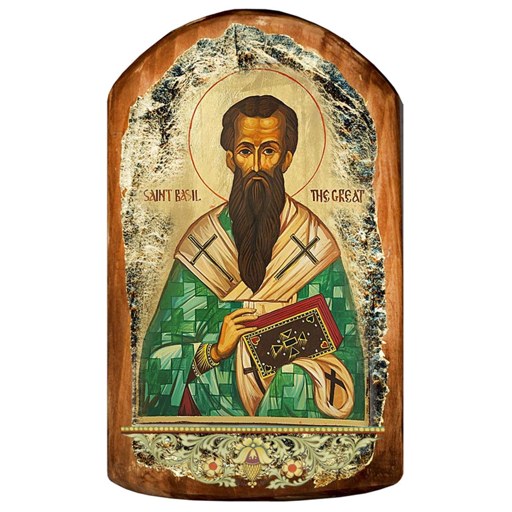
https://www.amazon.com/G-DeBrekht-85053-16-Painting-Gold-Plated-Wooden/dp/B08HPBCCKD
License: unknown
Basil of Seleucia
Saint- Gender
- male
- Church
- Catholic
Roles & Family
Biography
Basil of Seleucia was a fifth-century bishop and ecclesiastical writer of the Eastern Roman Empire. He held the metropolitan see of Seleucia in Isauria, also called Seleucia Trachaea, a coastal city of southern Asia Minor in the Roman province of Isauria, corresponding to the area of modern Silifke in Turkey. Nothing reliable is known of his family, education, or the date and place of his birth. He first appears in surviving sources as an established bishop during the Christological crisis of the 440s, when the churches of the East were divided over how to speak of the divinity and humanity of Christ after the Council of Ephesus of 431. His public shifts of position in those years illustrate the political and physical pressure under which many prelates then acted.
In November 448 Basil took part in the Home Synod of Constantinople presided over by Patriarch Flavian. That synod examined and condemned the archimandrite Eutyches, who was understood to deny that Christ remained consubstantial with humankind after the Incarnation, and Basil joined the condemnation. The following August he was present at the Second Council of Ephesus, assembled under Dioscorus of Alexandria and later branded the Latrocinium or Robber Council. There, amid intimidation by soldiers and monastic partisans, Basil reversed himself: he voted to rehabilitate Eutyches and to depose Flavian of Constantinople and other opponents of Dioscorus. When the Council of Chalcedon met in 451, Basil was among the bishops required to account for their conduct at Ephesus. He declared that he had subscribed under duress and out of fear. He then accepted the Tome of Pope Leo I, which affirmed two natures in the one person of Christ, signed the Chalcedonian definition, and was allowed to remain in his see.
Basil was also a preacher of some reputation. A substantial collection of Greek homilies circulated under his name; about forty sermons are transmitted in the manuscript tradition, although modern critics regard a number of them as doubtful or spurious. The pieces generally accepted as his exhibit the ornate, rhythmical rhetoric of the Asianic school and comment on Old and New Testament narratives as well as on liturgical commemorations. A lengthy hagiographical work on the life and posthumous miracles of Saint Thecla, whose great shrine stood at Seleucia in Isauria, has at times been ascribed to him, but that attribution is now generally rejected. Later Byzantine catenae quote Basil’s homilies, indicating that they continued to be read in the Greek East.
The last securely dated notice of Basil belongs to the year 458. In that year the Emperor Leo I circulated an encyclical asking the bishops of the empire for their judgment on the murder of the Chalcedonian patriarch Proterius of Alexandria and on the consecration of the anti-Chalcedonian Timothy Aelurus. Basil, together with the other bishops of Isauria, signed a reply upholding the Council of Chalcedon. His death is not recorded in any surviving source and must have occurred at an unknown date after 458. He was never patriarch of one of the great sees, and subsequent liturgical tradition did not develop a prominent cult or a universally observed feast in his honor. His historical importance lies in his participation in the assemblies of 448–451 and in the homiletic corpus that, whatever its exact boundaries, preserves a specimen of fifth-century Greek preaching from Isauria.