Basil the Elder is a saint of the Catholic Church (d. 349). Basil the Elder's feast day is celebrated on 30 May.
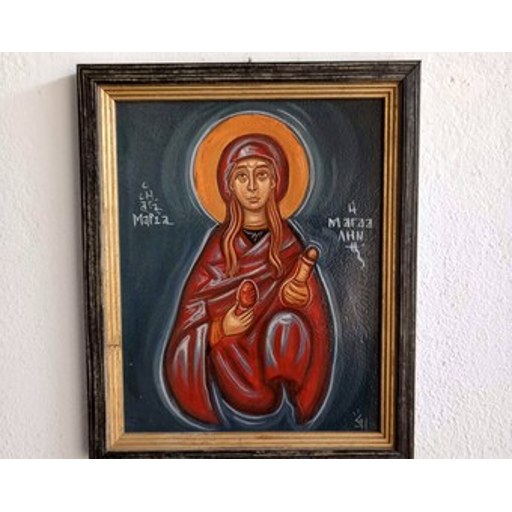
https://etsy.com/listing/1080427382/st-basil-the-great-of-caesaria-byzantine
License: unknown
Basil the Elder
Saint- Life Span
- d. 349
- Feast Day
- 30 May
- Gender
- male
- Church
- Catholic
Roles & Family
Religious Information
Biography
Basil the Elder, also called Basil of Caesarea the Elder, was a fourth-century Christian rhetorician and legal advocate from the Roman provinces of Pontus and Cappadocia in Asia Minor. He is remembered above all as the father of a family that produced several of the most influential saints of the Eastern Church, among them Basil of Caesarea (Basil the Great), Gregory of Nyssa, Peter of Sebaste, and Macrina the Younger. Almost everything that can be said about him with any confidence comes from later family and ecclesiastical writers, especially Gregory of Nyssa’s Life of Macrina and Gregory of Nazianzus’s funeral oration on Basil the Great. The year and place of his birth are not recorded in surviving sources.
He was the son of Macrina the Elder, a Christian of standing whose household had suffered in the persecutions of the early fourth century and who is associated in the tradition with the church of Neocaesarea and the legacy of Gregory Thaumaturgus. Basil the Elder himself rose to distinction as a teacher of rhetoric and as an advocate, practicing in Caesarea of Cappadocia, the chief city of the region. The family possessed substantial means and landed property, including an estate in Pontus in the district of Annesi on the Iris River, which later became the setting for the household’s monastic life.
He married Emmelia of Caesarea, herself from a Christian family and later venerated as a saint. Ancient accounts describe a large family of nine or ten children. The children who can be identified with reasonable certainty include Macrina the Younger, who became the spiritual head of a monastic community; Basil, who became bishop of Caesarea and a principal architect of later Trinitarian theology and monastic rules; Naucratius, who adopted an ascetic life and died young; Gregory, later bishop of Nyssa; and Peter, later bishop of Sebaste. A sister named Theosebia is mentioned in some sources as a deaconess. Basil the Elder and Emmelia gave their children both a classical education in rhetoric and philosophy and a rigorous Christian formation, a combination that shaped the so-called Cappadocian theological tradition.
Basil the Elder died in the mid-fourth century, conventionally dated to 349, while several of his children were still young or still in the course of their studies. After his death Emmelia administered the family’s affairs and, with Macrina, turned the Pontic estate into a monastic community. He held no episcopal or patriarchal office and was not a member of a religious order; he remained a layman. He is venerated as a saint in the Eastern Orthodox Church, commonly together with Emmelia on 30 May. His historical importance rests on the Christian household he helped to form rather than on public ecclesiastical acts of his own.