Beatrice of Ornacieux is a blessed of the Catholic Church (d. 1303).
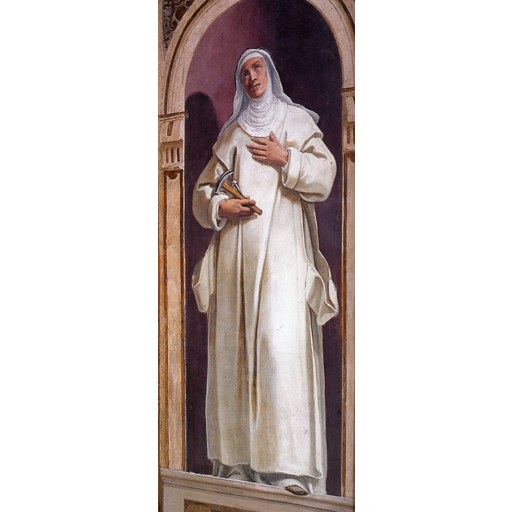
Daniele Crespi
License: Public domain
Beatrice of Ornacieux
Blessed- Life Span
- d. 1303
- Gender
- female
- Church
- Catholic
Places
Roles & Family
Religious Information
Canonization
Biography
Beatrice of Ornacieux (French: Béatrice d'Ornacieux) was a Carthusian nun and mystic of the later thirteenth century, later venerated as a blessed in the Roman Catholic Church. She was born at Ornacieux in the Dauphiné of Viennois, a territory then attached to the Holy Roman Empire and corresponding today to part of the department of Isère in southeastern France. The exact year of her birth is not preserved in any contemporary record; later tradition has placed it in the mid-thirteenth century, but that remains an estimate rather than a documented date. Her name is toponymic and indicates origin in a noble family of that locality. As a young woman she entered the Carthusian monastery of Parménie, near Beaucroissant, taking up the enclosed contemplative life of the Order founded by Saint Bruno of Cologne. Carthusian nuns of this period followed an observance closely related to that of the monks, with a strong emphasis on silence, cell, liturgical prayer, and perpetual enclosure.
The house at Parménie belonged to the small cluster of women’s Carthusian foundations in the region of Lyon and the Dauphiné. Almost everything that can be said of Beatrice’s interior life depends on a single medieval text: a vernacular vita composed by Margaret of Oingt (Marguerite d’Oingt), prioress of the Carthusian nunnery of Poleteins and one of the earliest known women writers in Franco-Provençal. That work, commonly cited as Li via seiti Biatrix, virgina de Ornaciu, presents Beatrice as a virgin of marked humility and obedience, given to severe penance and to prolonged meditation on the Passion of Christ. Within this hagiographical frame she appears as a mystic whose prayer included visions and a desire to be configured to the suffering Christ. Independent archival documentation of those experiences does not survive. Historians therefore read Margaret’s account both as spiritual edification in the Carthusian manner and as evidence for how nuns of that order in the late thirteenth century described sanctity.
In the later part of her life Beatrice was associated with the Carthusian nunnery of Eymeux, in what is now the department of Drôme. Tradition presents her as one of the nuns who helped to establish or consolidate that community, in keeping with a modest expansion of women’s Carthusian life in the Dauphiné around the turn of the fourteenth century. She died at Eymeux. Later martyrologies and order chronicles most often give the date as 25 November 1303, though some notices record 1309. She was buried in connection with the house at Eymeux. The medieval charterhouse there has not continued as a living community, and knowledge of her tomb rests on later tradition rather than on a continuous local cult with abundant medieval documentation.
Devotion to Beatrice remained largely confined to the Carthusian Order and to the churches of the Dauphiné. In the nineteenth century her cult was confirmed by Pope Pius IX, after which she has been styled Blessed Beatrice of Ornacieux. She was not the object of a papal canonization in the modern formal sense, and she has no widely attested patronage of places, professions, or causes. Calendars differ as to her liturgical commemoration, with dates in February and in November appearing in various Carthusian and local listings. Because the biographical record is thin and rests so heavily on one vita and on subsequent order tradition, many particulars—including the precise year of her birth and, in some reconstructions, of her death—remain uncertain. What can be affirmed with reasonable confidence is that she was a noble-born Carthusian nun of the Dauphiné, linked to Parménie and to Eymeux, remembered as a mystic and as a model of Carthusian observance, and beatified by confirmation of cult under Pius IX.