Benedict II is a saint of the Catholic Church (d. 685). Benedict II's feast day is celebrated on 7 May.
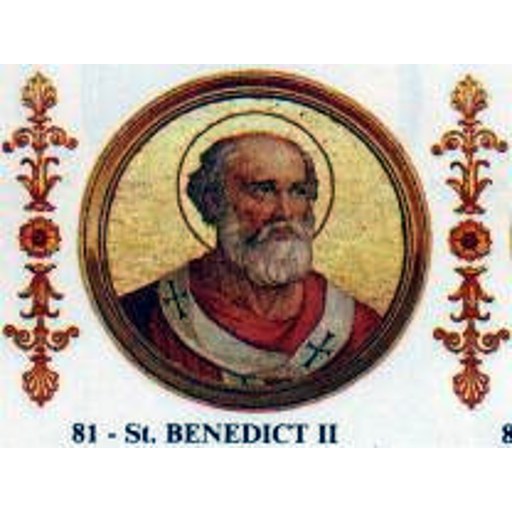
Unknown authorUnknown author
License: Public domain
Benedict II
Saint- Life Span
- d. 685
- Feast Day
- 7 May
- Gender
- male
- Church
- Catholic
Places
Relics & Where to Venerate
Location unknown
The bodily remains of Benedict II are a first-class relic. Venerated at St. Peter's Basilica.
Roles & Family
Biography
Pope Benedict II was a native of Rome and the son of a man named John. Surviving sources do not record the year of his birth. Before his election he was a priest of the Roman Church, described in the Liber Pontificalis as learned in the Scriptures, skilled in ecclesiastical chant, humble in manner, and generous toward the poor. After the death of Pope Leo II in June 683 the Roman clergy and people chose Benedict as bishop of Rome, but the long-standing requirement of imperial confirmation from Constantinople delayed his consecration until 26 June 684.
His brief pontificate coincided with a thaw in relations between Rome and the imperial court after the condemnation of Monothelitism at the Third Council of Constantinople (680–681). Benedict obtained from Emperor Constantine IV an important concession: confirmation of a newly elected pope could thereafter be given by the Exarch of Ravenna rather than being sought in distant Constantinople, thereby shortening the vacancies of the apostolic see. As a mark of favor the emperor sent the pope locks of hair from his sons Justinian and Heraclius, a ceremonial token of spiritual kinship.
Benedict restored several Roman churches, among them works at St. Peter’s and at St. Lawrence in Lucina, and he continued traditional papal almsgiving. From Visigothic Spain he received a profession of faith, forwarded by King Erwig and the Spanish bishops, affirming the decrees of the Sixth Ecumenical Council and thus aligning the Iberian Church with the Christology defined at Constantinople. These exchanges show his role in consolidating the anti-Monothelite settlement in the Latin West.
Benedict II died in Rome on 8 May 685 and was buried in St. Peter’s Basilica. He was succeeded by John V. Later tradition numbered him among the sainted popes; his liturgical commemoration is kept on 7 May. Because his reign lasted less than a year and the documentary record beyond the Liber Pontificalis is sparse, many particulars of his earlier career and personal life remain unknown.