Benedict of Nursia is a saint of the Catholic Church (480 - 547). Benedict of Nursia's feast day is celebrated on 11 July. Benedict of Nursia is the patron saint of Europe;monks;students;schoolchildren;farmers;agricultural workers;speleologists;civil engineers;Italian architects;coppersmiths;people in religious orders;dying people;against poison;against witchcraft;against temptations;kidney disease;gallstones;fever;inflammatory diseases;erysipelas;nettle rash;servants;Norcia.
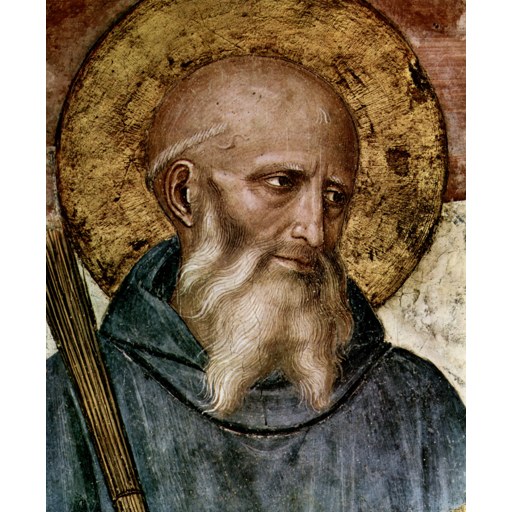
Fra Angelico
License: Public domain
Benedict of Nursia
Saint- Life Span
- 480 - 547 (age 67)
- Feast Day
- 11 July
- Gender
- male
- Church
- Catholic
Places
Sacred Places


Roles & Family
Religious Information
Patronage
Europe;monks;students;schoolchildren;farmers;agricultural workers;speleologists;civil engineers;Italian architects;coppersmiths;people in religious orders;dying people;against poison;against witchcraft;against temptations;kidney disease;gallstones;fever;inflammatory diseases;erysipelas;nettle rash;servants;Norcia
Biography
Benedict of Nursia, the principal founder of Western monasticism, was born in the late fifth century at Nursia (modern Norcia) in Umbria, in central Italy, to a family of the Roman provincial nobility. Almost everything that can be said of his life depends on the second book of the Dialogues of Pope Gregory the Great, written in the 590s, a generation after Benedict’s death, and on the later liturgical and monastic tradition that grew around that account. Gregory reports that the young Benedict was sent to Rome for a liberal education but was so distressed by the moral disorder of the city that he abandoned his studies and withdrew from public life. He stayed first at Affile (Effide) in the Simbruini hills, where a miracle involving a mended wheat sieve was already attributed to him, and then sought stricter solitude in a cave above the Anio at Subiaco. There he lived as a hermit for about three years, known only to a monk named Romanus, who supplied him with bread. Shepherds eventually discovered him, and his reputation for holiness began to draw disciples.
When a community of monks at Vicovaro asked him to become their abbot, Benedict consented, but they found his discipline intolerable and attempted to poison him; Gregory relates that the cup broke when Benedict blessed it. He returned to Subiaco and organized his growing following into twelve small monasteries, each under its own abbot, while he retained overall direction from a thirteenth house. Hostility from a local priest named Florentius, together with other conflicts, led him to leave the Subiaco valley. In the second quarter of the sixth century he settled on the height of Monte Cassino, on the road between Rome and Naples. There he is said to have overthrown remaining pagan shrines, converted the countryside, and founded the monastery that became the mother house of the Benedictine tradition. Gregory portrays him at Monte Cassino as a wonder-worker and a man of prophetic insight, including an encounter with the Ostrogothic king Totila.
It was at Monte Cassino that Benedict composed the Rule that bears his name, a comparatively short and moderate code for cenobitic life. The Rule orders the day around the opus Dei (the liturgical hours), sacred reading, and manual work, and it insists on stability, obedience, and humility under an abbot elected by the community. It draws on earlier Latin and Eastern monastic legislation, notably the anonymous Rule of the Master, but its discretion, concern for the weak, and practicality made it uniquely fitted to the Latin West. Benedict’s sister Scholastica, whom later tradition regards as his twin and who had been consecrated to God from childhood, is said to have visited him once a year. Gregory’s narrative of their last meeting—in which her prayer brought a storm that kept Benedict from returning to the monastery—and of his vision of her soul ascending to heaven as a dove became one of the best-known episodes in medieval hagiography.
Benedict died at Monte Cassino in the mid-sixth century. Gregory describes him as dying upright in prayer after receiving Communion, having foretold the day of his death to his monks. He was buried in the oratory of Saint John the Baptist on the mountain, in the same grave as Scholastica. The cult spread quickly; by the later sixth and seventh centuries the Rule was being copied and observed beyond Monte Cassino, and in the Carolingian age it became the normative monastic code of Western Europe. Original burial at Monte Cassino is the ancient tradition, although the abbey of Fleury (Saint-Benoît-sur-Loire) has claimed since the seventh century to possess relics translated from the ruined mountain. Benedict was never the object of a formal papal canonization of the later medieval type; his cult is pre-congregational and rests on Gregory’s Dialogues and uninterrupted monastic veneration. In 1964 Pope Paul VI declared him patron of Europe. The General Roman Calendar keeps his feast on 11 July (a date associated in some medieval sources with a translation of relics); 21 March was long observed as the day of his death, and the Byzantine churches commemorate him on 14 March.