Benedict XIII is a servant of god of the Catholic Church (1649 - 1730).
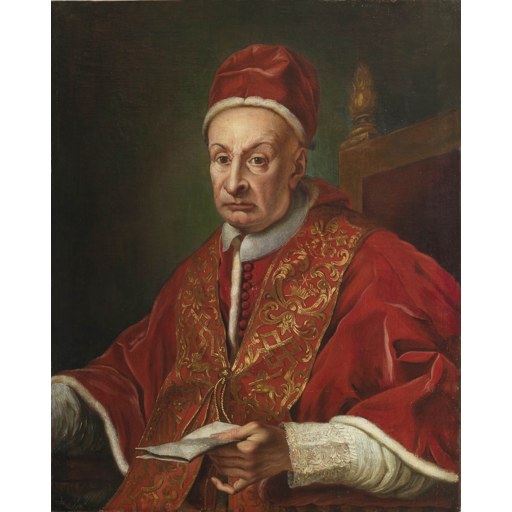
Unidentified painter
License: Public domain
Benedict XIII
Servant of God- Life Span
- 1649 - 1730 (age 81)
- Gender
- male
- Church
- Catholic
Places
Relics & Where to Venerate
Location unknown
The bodily remains of Benedict XIII are a first-class relic. Venerated at Santa Maria sopra Minerva.
Roles & Family
Religious Information
Biography
Pietro Francesco Orsini was born in 1649 at Gravina in Puglia, in the Kingdom of Naples, into a southern branch of the ancient Roman princely family of Orsini. As the eldest son of Ferdinando Orsini, duke of Gravina, he was expected to continue the family's secular fortunes. Instead, in his late teens he entered the Dominican Order, taking the name Vincenzo Maria. Relatives tried to have the vows set aside, appealing even to the Holy See, but he remained in the order. He studied philosophy and theology in Dominican houses of the Italian peninsula and was ordained a priest. His learning and birth soon drew the attention of the Roman Curia.
In 1672 Pope Clement X created him a cardinal at an unusually young age and assigned him to the archiepiscopal see of Manfredonia. Subsequent transfers took him to Cesena and, in 1686, to Benevento, which he governed for some thirty-eight years. There he earned a name as a resident, reforming bishop: he held synods, insisted on clerical residence and education, visited the parishes of a large diocese, and lived with the austerity of a friar rather than the display of a grandee. He sat in several conclaves and was counted among the zelanti, cardinals who wished the papacy to be less dependent on the Catholic monarchies.
The conclave that followed the death of Innocent XIII in 1724 chose the aged Orsini as a compromise. He accepted the papacy under the name Benedict XIII, in recollection of the Dominican pope Benedict XI. Already in his mid-seventies, he continued to wear the white habit of his order, to keep its fasts, and to occupy himself with pastoral, liturgical, and canonization causes more readily than with diplomacy or finance. During his pontificate he canonized a number of saints, among them John of the Cross, Aloysius Gonzaga, and Stanislaus Kostka, and he confirmed many cults. His long familiarity with Benevento, however, led him to place extraordinary trust in Niccolò Coscia and other clients from that city. Coscia, raised to the cardinalate, used his position to sell offices and to enrich himself, while the pope, personally detached from money, failed to check the abuse.
Benedict XIII died in Rome in 1730. Under his successor, Clement XII, Coscia was tried, stripped of his dignities for a time, and imprisoned. Later generations have generally distinguished the pope's personal piety and Dominican simplicity from the administrative weakness of his government of the Papal States. He was buried, according to his wishes as a friar, in the Dominican basilica of Santa Maria sopra Minerva in Rome. He has never been beatified or canonized, and the Catholic Church assigns him no feast day or official patronage.