Benincasa is a blessed of the Catholic Church (1375 - 1426). Benincasa's feast day is celebrated on 9 January.
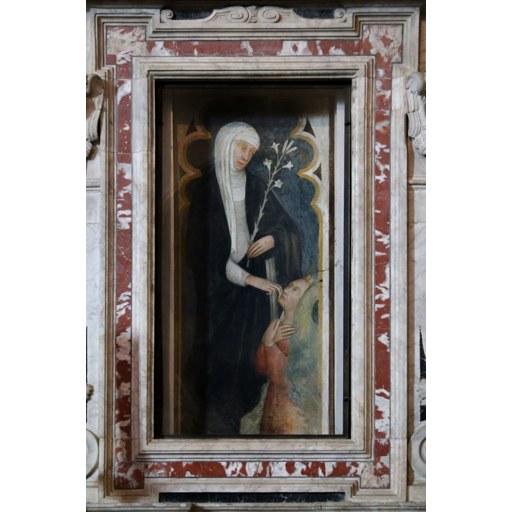
https://www.thediarist.ph/siena-my-facetime-with-relics-of-kick-ass-saint-the-original-influencer/
License: unknown
Benincasa
Blessed- Life Span
- 1375 - 1426 (age 51)
- Feast Day
- 9 January
- Gender
- male
- Church
- Catholic
Places
Roles & Family
Religious Information
Canonization
Biography
Blessed Benincasa was born in 1375 in Montepulciano, a hill town in southern Tuscany then under the influence of the Republic of Siena. Little is recorded of his family background or childhood. As a young man he entered the Order of the Servants of Mary, commonly called the Servites, in the convent of his native town. The Servites had originated in thirteenth-century Florence among lay penitents devoted to the Sorrows of the Virgin Mary and by the late fourteenth century maintained several houses in Tuscany. Benincasa lived for a time the common life of the order, which joined liturgical prayer with preaching and works of charity.
Seeking a more austere path, he obtained permission from his superiors to live as a hermit while remaining a professed Servite. He withdrew to a solitary dwelling near Monticchiello on the slopes of Monte Amiata. There he spent the rest of his life in poverty, fasting, manual labor, and prolonged prayer. Local people came to him for spiritual advice, and he acquired a reputation for holiness during his lifetime. His choice of solitude within a mendicant order reflects a pattern found among some Italian religious of the period, who combined the vows of an established community with the eremitical tradition of the countryside.
Benincasa died on 9 January 1426 at his hermitage. A popular cult quickly formed. Miracles were attributed to his intercession, and the faithful of the region continued to honor his memory. The Servite Order preserved the tradition of his sanctity. In 1829 Pope Pius VIII confirmed the ancient cult paid to him, thereby granting him the title of Blessed. His liturgical commemoration is kept on 9 January, especially by the Servites and in the dioceses of Tuscany.
Documentary evidence for the particulars of his life is limited, consisting mainly of later hagiographical notices and the records connected with the nineteenth-century confirmation of his cult. He remains a regional figure of devotion, remembered as an example of contemplative penance and Marian spirituality within the Servite family in late medieval and early Renaissance Italy.