Benno is a saint of the Catholic Church (d. 1106). Benno's feast day is celebrated on 16 June. Benno is the patron saint of Munich;fishermen;weavers;Diocese of Dresden-Meissen.
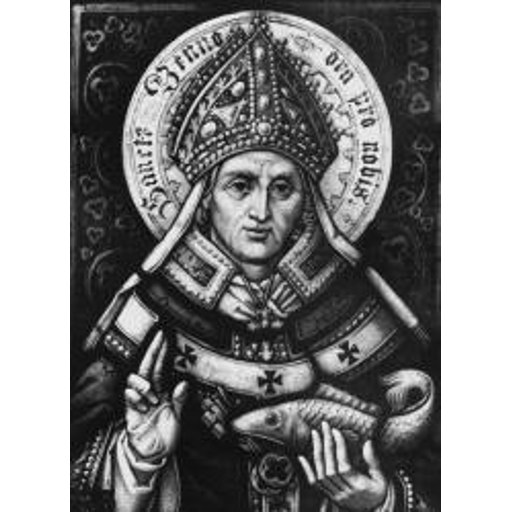
User Kmorozov on en.wikipedia
License: Public domain
Benno
Saint- Life Span
- d. 1106
- Feast Day
- 16 June
- Gender
- male
- Church
- Catholic
Places
Relics & Where to Venerate
Location unknown
The bodily remains of Benno are a first-class relic. Venerated at Frauenkirche.
Roles & Family
Patronage
Munich;fishermen;weavers;Diocese of Dresden-Meissen
Canonization
Biography
Benno of Meissen was Bishop of Meissen from 1066 until his death in 1106 and is venerated as a saint in the Roman Catholic Church. Secure contemporary evidence for his early life is thin. A much later vita, composed in the early sixteenth century by Hieronymus Emser in connection with the campaign for his canonization, presents him as a Saxon noble, sometimes linked to the counts of Woldenburg, born around the beginning of the eleventh century and associated with Hildesheim and the Benedictine monastery of St. Michael there. Historians treat those biographical particulars as traditional rather than firmly documented. In better-attested sources he appears as a canon of the imperial collegiate church at Goslar before Emperor Henry IV named him to the see of Meissen, a frontier diocese in the Saxon east, among a largely Sorbian population.
His long episcopate fell in the years of the Saxon revolts and the Investiture Controversy. Chroniclers such as Lampert of Hersfeld place him among the Saxon bishops whose loyalty to Henry IV was in doubt. He was accused of complicity in the destruction of royal fortifications, was imprisoned for a time, and was temporarily removed from his see before being restored. His alignments shifted with the politics of the empire and the papacy: he is associated at points with the anti-imperial Saxon party and later with reconciliation to the emperor. The precise sequence and motives remain debated because the narrative sources are partisan and incomplete. What can be said with confidence is that he survived as bishop through decades of civil and ecclesiastical conflict on the eastern Saxon border.
Later hagiography credits him with missionary work among the Slavs of the diocese, with church building and restoration, and with support of monastic life. These claims cannot always be corroborated in eleventh-century documents and belong in part to the sixteenth-century shaping of his cult. Two legendary cycles became especially important. One tells that, when driven from Meissen, he cast the cathedral keys into the Elbe, and that a fish later brought them up—hence his patronage of fishermen. Another associates him with rain and fertility miracles, which underlay later invocation against drought. Such stories illustrate how a relatively poorly documented imperial bishop was transformed into a wonder-working diocesan founder in the late medieval and early modern imagination.
Benno died on 16 June 1106 and was buried in Meissen Cathedral, where a local cult grew up at his tomb. Formal canonization came only on 31 May 1523, when Pope Adrian VI, pressed by Duke George of Saxony, declared him a saint. The act was entangled in the first years of the Reformation in Saxony: Catholics promoted Benno as a regional saint, while Protestant pamphleteers mocked the cult. After Albertine Saxony adopted the Reformation in 1539, the relics were removed from Meissen. They later passed to Bavaria; Duke Albert V had them enshrined in the Frauenkirche in Munich. From that translation Benno became a principal patron of Munich. His feast is kept on 16 June. He is invoked as patron of Munich, of fishermen and weavers, and of the historic see of Meissen, continued in the modern Diocese of Dresden-Meissen.