Beorhthelm of Stafford is a saint of the Catholic Church. Beorhthelm of Stafford's feast day is celebrated on 10 August. Beorhthelm of Stafford is the patron saint of Stafford.
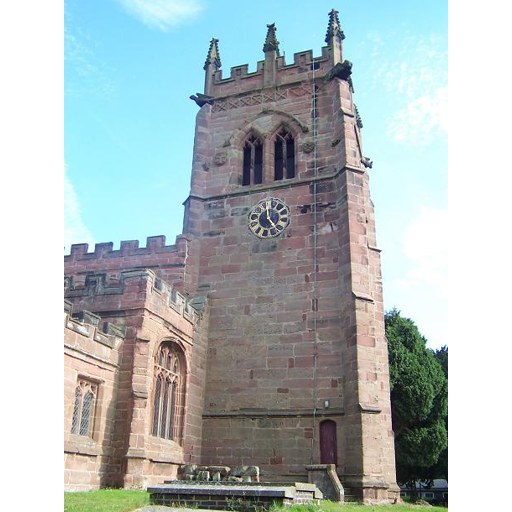
Adrian Bailey
License: CC BY-SA 2.0
Beorhthelm of Stafford
Saint- Feast Day
- 10 August
- Gender
- male
- Church
- Catholic
Places
Roles & Family
Patronage
Stafford
Biography
Beorhthelm of Stafford, whose Old English name was later rendered as Bertelin, Berthelm, or Bertram, was an Anglo-Saxon saint whose cult was centred on Stafford in the kingdom of Mercia, in the midlands of what is now England. He is customarily placed in the eighth century, but no contemporary vita survives and almost no biographical detail can be verified from sources close to his own lifetime. The earliest substantial witness to his veneration is the Old English catalogue of saints' resting-places known as the Secgan, assembled in the eleventh century, which states that Beorhthelm rests at Stafford. That entry demonstrates that by the late Anglo-Saxon period a recognised local cult existed and that his tomb or relics were believed to lie in the town. The personal name Beorhthelm, meaning roughly 'bright helmet', is well attested in Mercia and Wessex; it was also borne by several later tenth-century bishops, who should not be identified with the Stafford hermit.
Later medieval and antiquarian tradition portrays him as a hermit. He is said to have lived on a marshy island called Bethnei (sometimes Bertelinei), which folk memory treated as the original nucleus of Stafford, at a time when the site was still wet ground among the rivers Sow and Penk rather than the fortified burh that Aethelflaed, Lady of the Mercians, established there in the early tenth century. In 1954 archaeological excavation on the site of the former church of St Bertelin, immediately west of St Mary's Collegiate Church in Stafford, directed by Adrian Oswald, revealed the remains of a wooden preaching cross and of a small subsequent stone church. The sequence is consistent with an early Christian station that grew into a church dedicated to the saint, although archaeology cannot confirm the hermit's existence or dates. St Bertelin's church continued as a place of local devotion through the Middle Ages. It went out of use after the Reformation, was eventually demolished, and is now represented by marked foundations and a small modern chapel on the same plot.
Hagiographical legend, much of it written down only in the later Middle Ages or collected by sixteenth- and seventeenth-century antiquaries, supplies a more elaborate narrative that cannot be controlled by early evidence. In some versions Beorhthelm is a prince or high-born Mercian who renounced secular rank for solitude and prayer. A closely related cycle of stories belongs to Saint Bertram or Bertelin of Ilam, in the Staffordshire Peak District, where a holy well, a medieval shrine base, and a tomb-chest in the parish church of the Holy Cross became objects of pilgrimage. That legend makes the saint a Mercian royal who crossed to Ireland, married an Irish princess, and came home with her and an infant; wolves killed the mother and child, after which the father lived out his days as a hermit at Ilam. Historians have long disagreed as to whether the Stafford and Ilam cults commemorate a single person whose memory was divided between two centres, or two similarly named holy men who were later fused in popular tradition. The surviving evidence does not allow the question to be settled.
Because the documentary record is so sparse, further claims—that Beorhthelm was a disciple of Saint Guthlac of Crowland, that he received baptism from a named bishop, or that he travelled as a pilgrim to Rome or Ireland—remain late and unverified traditions rather than established facts. He held neither the papacy nor a patriarchal see, and there is no sound reason to identify him with any of the English bishops named Beorhthelm who appear in tenth-century charters and chronicles. His sanctity was of the early medieval local type, grounded in tomb-cult and regional memory rather than in a formal papal canonisation of the kind that developed later. He is regarded as the patron saint of Stafford. Western calendars have commonly assigned him the feast of 10 August, though observances connected with the Ilam shrine have also been noted in local practice. The Reformation dispersed whatever relics remained at Stafford, and modern knowledge of the saint depends on the Secgan, on the archaeology of St Bertelin's site, and on a thin overlay of medieval and antiquarian legend.