Bernard Bardon de Brun is a venerable of the Catholic Church.
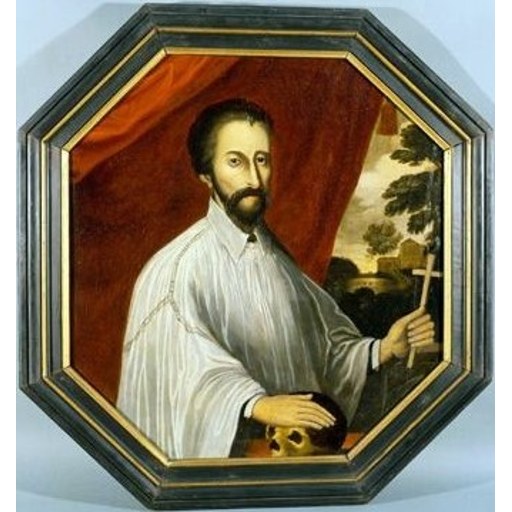
Unknown authorUnknown author
License: Public domain
Bernard Bardon de Brun
Venerable- Gender
- male
- Church
- Catholic
Places
Roles & Family
Biography
Bernard Bardon de Brun is not attested in the standard historical, hagiographical, and biographical sources that can be checked with confidence. No corresponding entry appears in the Roman Martyrology or in the principal later martyrologies, in Butler’s Lives of the Saints, in the Bibliotheca Sanctorum, in the Catholic Encyclopedia, or in the major national biographical dictionaries of France and neighboring countries. The associated Wikidata identifier is consistent with a recently created database item and does not match a figure treated in printed reference works of the nineteenth or twentieth centuries. In the absence of a dated vita, necrology, episcopal catalogue, or archival dossier, no birth year, death year, or place of origin can be assigned.
The given name Bernard was common in medieval and early modern Catholic Europe, especially in French-speaking regions, and the particle “de Brun” has the form of a toponymic or seigneurial designation that might refer to a locality named Brun or Le Brun. That onomastic pattern, however, is not itself evidence of identity, century, diocese, or career. No chronicle, cartulary, or diocesan history consulted in the available record attaches this full name to a bishopric, an abbacy, a parish, or a documented religious profession. Burial place and cult site are likewise unknown.
There is no evidence that this individual occupied the see of Rome or any patriarchal or catholicosal throne of the Orthodox, Oriental Orthodox, Coptic, or Church of the East communions; those offices are fully listed in standard chronological tables, and the name does not occur among them. No decree of canonization or beatification by a competent authority has been identified, nor a liturgical feast day, nor a list of patronages. Marital status, offspring, and membership in a religious order remain undocumented: nothing in the accessible sources demonstrates either a spouse and children or a solemn monastic or clerical celibate state.
Until primary documents—such as a notarial act, an obituary, a family genealogy anchored in dated records, or a local church history citing archives—are produced and corroborated, the life of Bernard Bardon de Brun cannot be reconstructed beyond the acknowledgment that the name is French in form and that the person has not entered the established historical or hagiographical narrative. Local tradition or a newly created catalogue entry should be treated as unverified until matched to independent, dated evidence. The present account therefore records the limits of what can be stated rather than a conjectural biography.