Bernard degli Uberti is a saint of the Catholic Church (d. 1133). Bernard degli Uberti's feast day is celebrated on 4 December. Bernard degli Uberti is the patron saint of Parma.
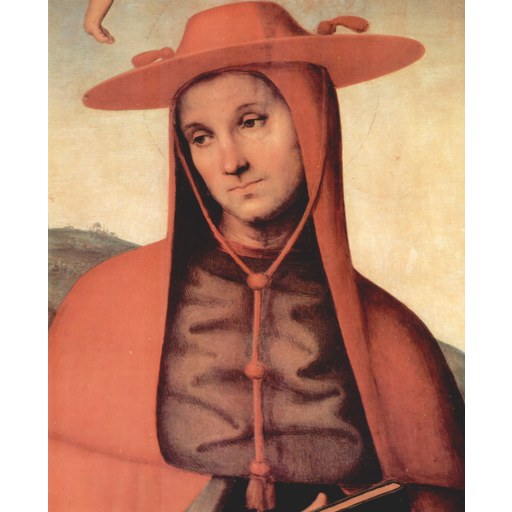
Pietro Perugino
License: Public domain
Bernard degli Uberti
Saint- Life Span
- d. 1133
- Feast Day
- 4 December
- Gender
- male
- Church
- Catholic
Places
Relics & Where to Venerate
Location unknown
The bodily remains of Bernard degli Uberti are a first-class relic. Venerated at Parma Cathedral.
Roles & Family
Religious Information
Patronage
Parma
Canonization
Biography
Bernard degli Uberti belonged to the Uberti, a prominent noble lineage of Florence, and was born in that city in the latter part of the eleventh century. Precise documentation of his birth year has not survived, and later notices that place it around 1060 remain conjectural. As a young man he entered the Vallombrosan Congregation, the Benedictine reform founded by John Gualbert at Vallombrosa in the Tuscan Apennines. The Vallombrosans were distinguished in eleventh-century Italy for their campaign against simony and Nicolaitism and for a strict common life. Bernard was trained in that observance and rose to govern the important Vallombrosan house of San Salvi, just outside Florence, before being elected abbot-general of the congregation near the end of the century.
His standing among the Italian reformers brought him to the attention of the papacy. Pope Urban II, himself a former Cluniac monk and a principal heir of Gregory VII’s program, created Bernard a cardinal in the closing years of the eleventh century. In that capacity Bernard served as a counsellor and as a papal legate in northern Italy, working to secure acceptance of the reform decrees and to strengthen monastic and clerical discipline. In 1106 Pope Paschal II entrusted him with the bishopric of Parma. The see lay in a region where imperial influence was strong and where the contest over investiture was especially bitter; the appointment was therefore both a pastoral charge and a political act in defense of the liberty of the Church.
Parma’s communal elites and clergy aligned with the emperor did not readily accept a bishop so closely identified with the papal cause. Bernard was expelled from the city on more than one occasion and, according to the medieval accounts of his life, endured captivity and public humiliation before being restored. Despite these reversals he retained the see for the remainder of his life, a tenure of some twenty-seven years. He sought to reform the cathedral clergy, to protect ecclesiastical property, and to implant Vallombrosan and other reformed monastic houses in the diocese. He continued to act as a legate for Paschal II and his successors in Lombardy, and he remained a consistent supporter of the Roman pontiffs against imperial antipopes and against bishops who accepted lay investiture.
Bernard died in Parma on 4 December 1133 and was buried in the cathedral there. A cult developed promptly around his tomb, encouraged by reports of miracles and by the memory of his steadfastness during the investiture conflict. Traditional hagiography records that Pope Innocent II formally recognized his sanctity in 1139, only a few years after his death. He is venerated as a patron of the city and diocese of Parma; his feast is observed on 4 December. His relics remain in Parma Cathedral, where later chapels and artistic commissions have commemorated him as bishop, cardinal, and Vallombrosan monk.