Bernardo Tolomei is a saint of the Catholic Church (1272 - 1348). Bernardo Tolomei's feast day is celebrated on 20 August.
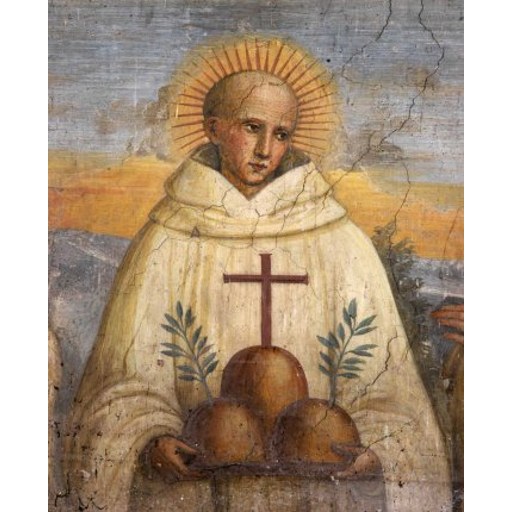
Unknown authorUnknown author
License: Public domain
Bernardo Tolomei
Saint- Life Span
- 1272 - 1348 (age 76)
- Feast Day
- 20 August
- Gender
- male
- Church
- Catholic
Places
Roles & Family
Religious Information
Canonization
Biography
Giovanni Tolomei, known in religion as Bernardo, was born in 1272 in Siena, then a self-governing Tuscan republic, into the noble Tolomei family. He received a substantial education and studied law, preparing for the public career expected of a man of his rank. In early adulthood he took part in the civic life of Siena, holding offices typical of the communal aristocracy. Later tradition, widely repeated in Olivetan and Sienese sources, associates a period of impaired sight—sometimes described as temporary blindness—in the early fourteenth century with a decisive turn toward a more strictly religious life. He did not, on the evidence that survives, marry or found a household of his own before leaving the world.
Around 1313 he withdrew with two companions of similar standing, Patrizio Patrizi and Ambrogio Piccolomini, to a rural property of his family at Accona in the Crete Senesi, the eroded clay hills south of Siena. There they lived as hermits in poverty, prayer, and manual work. Giovanni took the name Bernardo in honour of Bernard of Clairvaux. Others joined them. In 1319 Guido Tarlati, bishop of Arezzo, whose jurisdiction then covered the district, gave the little community the Rule of Saint Benedict and a white habit. The foundation was placed under the title of Santa Maria di Monte Oliveto, evoking both the local olive groves and the Mount of Olives. From this eremitical beginning grew the mother house of Monte Oliveto Maggiore and, in time, a distinct Benedictine congregation, the Olivetans, marked by the white habit and a strong Marian dedication.
Bernardo served repeatedly as abbot, though accounts of his life also record that he laid down the office at intervals and was later re-elected, a pattern later writers treated as a sign of humility. He insisted on regular Benedictine observance, the Divine Office, and works of charity. The congregation expanded through daughter houses in central Italy during the first half of the fourteenth century and obtained further ecclesiastical recognition; papal confirmation of the Olivetan institute belongs to this period. The founder remained closely identified with the Sienese landscape and with the abbey that still dominates the Crete Senesi.
In 1348, during the Black Death, Bernardo left the abbey for Siena in order to care for stricken monks and townspeople. He contracted the plague and died there on 20 August 1348. He was first buried in Siena; his relics came to be associated with Monte Oliveto Maggiore, where his memory was kept by the congregation he had founded. A local cult developed among the Olivetans and in Tuscany. Pope Urban VIII confirmed that cult in 1644, which in later canonical practice amounted to beatification. After a modern process, Pope Benedict XVI canonized him on 26 April 2009. His feast is kept on 20 August.