Bernward of Hildesheim is a venerable of the Catholic Church (d. 1022). Bernward of Hildesheim's feast day is celebrated on 20 November. Bernward of Hildesheim is the patron saint of Hildesheim;goldsmiths;architects;painters;sculptors.
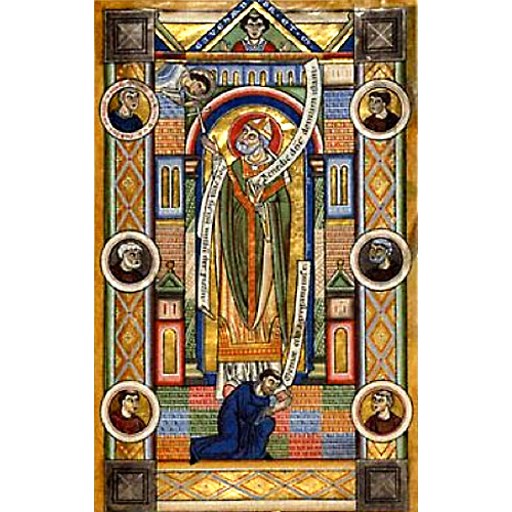
unbekannter Künstler
License: Public domain
Bernward of Hildesheim
Venerable- Life Span
- d. 1022
- Feast Day
- 20 November
- Gender
- male
- Church
- Catholic
Places
Roles & Family
Patronage
Hildesheim;goldsmiths;architects;painters;sculptors
Canonization
Biography
Bernward of Hildesheim was a Saxon churchman of the Ottonian age who served as Bishop of Hildesheim from 993 until his death in 1022 and is remembered as one of the foremost ecclesiastical patrons of the arts in early medieval Germany. He was born in the mid-tenth century into a noble Saxon family allied to the Ottonian imperial house; his grandfather Adalbero held the dignity of count palatine in Saxony. Orphaned while still young, he was entrusted to his uncle Volkmar, Bishop of Utrecht, and received a rigorous education at the cathedral school of Hildesheim under the scholar Thangmar, who later composed Bernward’s biography, the principal narrative source for his life. Besides theology and the liberal arts he acquired practical knowledge of metalworking, architecture, and the making of books, skills that later shaped the commissions associated with his name.
After his studies he entered imperial service. He became a chaplain at the court of the Empress Theophanu and was appointed tutor to the young Otto III. In 993 Otto III named him bishop of Hildesheim. As diocesan bishop he combined pastoral care and administration with an ambitious programme of building and artistic patronage that made Hildesheim a leading centre of Ottonian art. Around the beginning of the eleventh century he founded the Benedictine monastery of St. Michael and began its church; the crypt was consecrated in 1015 and the church itself in 1022, only weeks before his death. For Hildesheim Cathedral he commissioned a pair of monumental cast-bronze doors, dated by inscription to 1015, whose reliefs present scenes from Genesis and the life of Christ, and a bronze column with a spiral narrative of New Testament episodes, works that stand among the outstanding achievements of early medieval metal casting in the Latin West. He also sponsored richly illuminated manuscripts, among them the so-called Bernward Gospels, together with crosses, candlesticks, and other liturgical objects.
Bernward’s episcopate was not confined to the arts. He travelled to Rome, obtained relics, and was influenced by ancient and early Christian monuments he saw there. He was drawn into a prolonged jurisdictional conflict with Archbishop Willigis of Mainz over the convent of Gandersheim, a dispute that involved synods, imperial intervention, and appeals to the papacy. On the Saxon frontier he took part in the military defence of his diocese. He died at Hildesheim on 20 November 1022 and was buried in St. Michael’s Church, the monastery church he had founded and whose consecration he had just attended.
A cult developed at his tomb in the following generations. Pope Celestine III canonized him in 1193. His feast is kept on 20 November. He is invoked as patron of Hildesheim and of goldsmiths, architects, painters, and sculptors, a recognition of the artistic legacy attached to his episcopate. St. Michael’s Church and Hildesheim Cathedral, which house the bronze doors, the column, and related works associated with him, remain the principal monuments of his patronage.