Bilihildis is a saint of the Catholic Church (d. 734). Bilihildis's feast day is celebrated on 27 November.
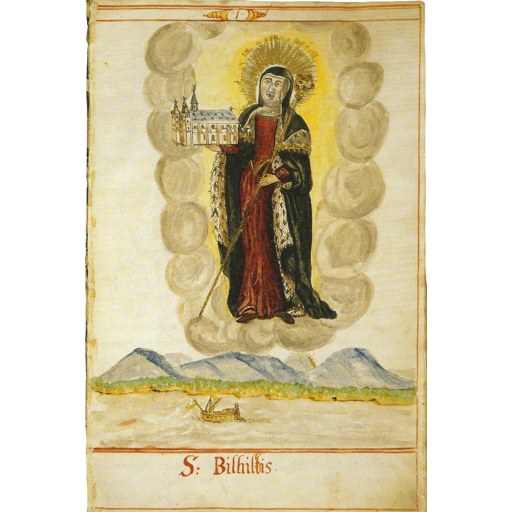
Unknown authorUnknown author
License: Public domain
Bilihildis
Saint- Life Span
- d. 734
- Feast Day
- 27 November
- Gender
- female
- Church
- Catholic
Places
Roles & Family
Religious Information
Biography
Bilihildis (also rendered Bilhild, Bilhildis, or Saint Bilhildis of Altmünster) was a Frankish noblewoman of the seventh and early eighth centuries, remembered as the foundress and first abbess of the monastery of Altmünster in Mainz. Virtually every narrative detail of her life comes from a Latin vita written in the twelfth century, centuries after the events it describes. Historians therefore treat the vita as a work of hagiography rather than as a contemporary record: it preserves the local cult and the monastery’s foundation legend, but it cannot be used as a reliable witness for genealogy, chronology, or political connections in the late Merovingian Rhineland. No eighth-century charter or chronicle names her parents or records a precise place of birth. Later tradition sometimes associates her family with the Würzburg region or with the Frankish aristocracy of the middle Rhine; those claims remain unverified.
The same vita states that Bilihildis was married to a Thuringian duke called Hetan, a figure often equated in later writing with Duke Hedan II of Thuringia. That identification is chronologically and politically fragile and is widely regarded as a legendary embellishment intended to give the foundress a distinguished widowhood. What the tradition consistently maintains, and what became central to her cult, is that she entered religious life after the death of a husband and devoted her property to a monastic foundation. Whether she had children is not recorded in any source that can be tested. After she was widowed she is said to have gone to Mainz and, with the encouragement of Bishop Rigibert of Mainz (a historically attested bishop of the late seventh and early eighth centuries), to have established a community of nuns dedicated to the Virgin Mary.
That house became known as Altmünster, the “old monastery,” to distinguish it from later foundations in the city. It is generally described as a Benedictine nunnery, one of the early female religious houses of the middle Rhine. Bilihildis is presented as its first abbess, governing the community she had endowed. The existence of an early medieval nunnery on the Altmünster site is not in doubt; what cannot be confirmed from contemporary evidence is the exact year of foundation or the full scope of her personal role. In the religious landscape of Austrasian Mainz, a noble widow’s conversion of family wealth into a monastic house fits a well-attested Frankish pattern of the seventh and eighth centuries, even if the individual biography has been shaped by later legend.
According to the liturgical and hagiographical tradition she died at Altmünster in Mainz in 734, on the day later kept as her feast, 27 November, and was buried in her monastery. Relics associated with her were preserved there. Her cult remained essentially local, centred on the diocese of Mainz; she was honoured as a saint by popular and diocesan veneration rather than by a recorded papal canonization, as was normal for figures of the pre-congregation era. Altmünster itself continued through the Middle Ages, later as a house of canonesses, before eventual dissolution, but the memory of its foundress stayed part of the city’s religious history.
Beyond this outline almost nothing can be established with certainty. Bilihildis belongs to the large group of early medieval noblewomen whose widowhood and monastic patronage became the core of a saint’s legend. Her historical importance lies in the enduring association of her name with one of Mainz’s oldest religious houses and in the continuity of her feast on 27 November, not in a recoverable court career or a documented family tree. Cautious reading of the twelfth-century vita, together with the independent fact of the Mainz nunnery, is as far as the evidence securely goes.