Bishop Alexander is a saint of the Catholic Church (d. 328). Bishop Alexander's feast day is celebrated on 26 February (Latin); 29 May (Byzantine); 17 April (Coptic).
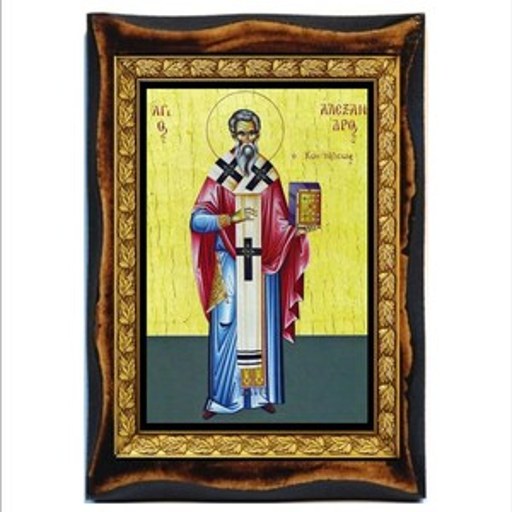
https://www.etsy.com/market/saint_alexander_icon
License: unknown
Bishop Alexander
Saint- Life Span
- d. 328
- Feast Day
- 26 February (Latin); 29 May (Byzantine); 17 April (Coptic)
- Gender
- male
- Church
- Catholic
Places
Roles & Family
Biography
Alexander of Alexandria was bishop of Alexandria in the early fourth century, occupying a see already styled a patriarchate and, in Egyptian Christian usage, a papacy. He succeeded Achillas about 313, after the Diocletianic persecution had ended and while Constantine’s changing policy toward the churches was still unfolding. Almost nothing historically secure is known of his family, birthplace, or year of birth; later tradition only places him among the Alexandrian clergy before his elevation. He inherited a church still divided by the Melitian schism, which had begun when Melitius of Lycopolis ordained clergy during the persecution in defiance of the imprisoned bishop Peter of Alexandria. Contemporary and near-contemporary narrative depends mainly on later ecclesiastical historians (Socrates, Sozomen, Theodoret) and on the circle of Athanasius, so many personal details remain beyond verification.
His episcopate is remembered above all for the outbreak of the Arian controversy. Arius, a presbyter associated with the Alexandrian parish of Baucalis, taught that the Son was a created being and not co-eternal with the Father. After local debate and a synod of Egyptian and Libyan bishops, Alexander condemned the teaching and deposed Arius and his leading supporters. He then sent encyclical letters to other churches, including a well-known letter addressed to another bishop Alexander (of Byzantium/Constantinople, or in some reconstructions of Thessalonica), setting out the Alexandrian doctrinal case. Sources portray him as personally mild and reluctant to break communion, yet unwilling to yield on the full divinity of the Son. The quarrel did not remain a local disciplinary affair: bishops such as Eusebius of Nicomedia sheltered Arius, and after 324 Constantine pressed for a settlement in the interest of imperial order.
Alexander, accompanied by his archdeacon Athanasius, was a principal figure at the Council of Nicaea in 325. The council’s creed and its anathemas against Arian formulae reflected the Alexandrian position, even though the later fourth century showed how unstable that settlement would be. He returned to Egypt with the council’s decisions and with imperial backing for the exile of Arius. He did not long survive the council. He died at Alexandria; modern reference works most often give 328 (some older Western authorities give 326), and he was succeeded by Athanasius, whose contested election opened the next phase of the same conflict.
Alexander is commemorated as a saint in the Catholic, Eastern Orthodox, and Oriental Orthodox churches. Feast days differ by calendar: 26 February in much of the Latin tradition, 29 May in the Byzantine rite, and 17 April (22 Baramudah) in the Coptic church. He is counted in Coptic lists as a Pope of Alexandria (commonly the nineteenth) and is therefore both patriarch of that see and, in the Egyptian sense, pope. No medieval religious order claims him as a founder, and there is no historically secure, comprehensive list of particular patronages attached to his name. His own writings survive only in part, chiefly letters concerning Arius and the Melitians, quoted or summarized by later historians rather than transmitted as a complete corpus.