Bishop Denis is a saint of the Catholic Church. Bishop Denis's feast day is celebrated on 9 October. Bishop Denis is the patron saint of France;Paris;against headaches;against frenzy;against strife;against hydrophobia;possessed people.
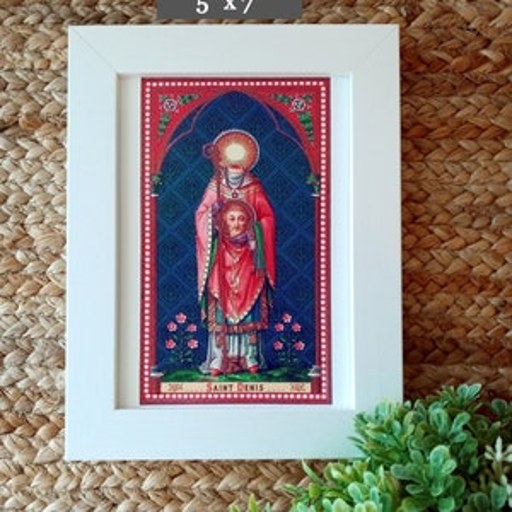
https://www.etsy.com/market/saint_denis_icon
License: unknown
Bishop Denis
Saint- Feast Day
- 9 October
- Gender
- male
- Church
- Catholic
Places
Roles & Family
Patronage
France;Paris;against headaches;against frenzy;against strife;against hydrophobia;possessed people
Biography
Saint Denis (Latin Dionysius), first bishop of Paris, is the third-century missionary martyr around whom the great royal abbey of Saint-Denis later grew. The earliest substantial notice is in Gregory of Tours in the sixth century, who names Denis among seven bishops sent into Gaul in a time of persecution associated with the emperor Decius and assigns him to the city of the Parisii. No contemporary source records his birth, family, or native country. Later medieval writers, especially from the ninth century, identified him with Dionysius the Areopagite of Acts and with the author of the Pseudo-Dionysian writings; historians treat those identifications as legendary conflations of distinct figures, not as biography.
Hagiographical tradition, developed in the early medieval Passio, says that Denis preached at Lutetia with the priest Rusticus and the deacon Eleutherius, that they were arrested and beheaded, and that the execution took place on the hill later called Montmartre. The same legend makes Denis a cephalophore: after decapitation he is said to have taken up his head and walked to the place he chose for burial. Whatever the historical kernel of the martyrdom, a tomb north of Paris was venerated as his. A church rose over it and became the Abbey of Saint-Denis, necropolis of the French kings. Precise years of birth and death are not verified; traditional dates in the mid-third century (often associated with Decius or the following decade) remain approximate.
The cult was already established in Merovingian Gaul and expanded under the Carolingians and Capetians. The abbey church, rebuilt in the twelfth century under Abbot Suger, stood at the centre of royal ritual and of early Gothic architecture. Denis was honoured as a patron of the French monarchy and of France. In art he appears as a bishop, often carrying his own mitred head. His feast is 9 October in the Roman Martyrology. Because of the beheading tradition he has been invoked against headaches; he is also listed among patrons of Paris and of France, and has been called upon in cases of frenzy, strife, hydrophobia, and possession.
Only a modest outline can be affirmed with confidence: a missionary bishop among the Parisii in the mid-third century, put to death in a persecution, and commemorated at a shrine that became one of the principal churches of medieval Europe. Colourful episodes of the Passio and exact chronology belong to later hagiography rather than to contemporary record. His lasting importance lies as much in the royal and national cult formed around his tomb as in the sparse recoverable facts of his life.