Bishop Sophronius is a saint of the Catholic Church (d. 638). Bishop Sophronius's feast day is celebrated on 11 March.
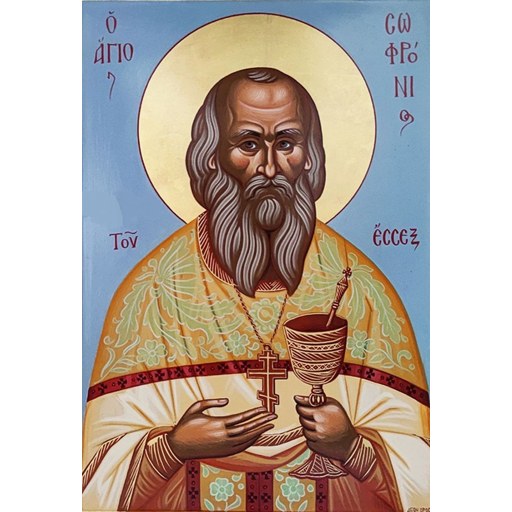
https://handmadeiconsgreece.myshopify.com/en-us/products/saint-sophronius-of-essex
License: unknown
Bishop Sophronius
Saint- Life Span
- d. 638
- Feast Day
- 11 March
- Gender
- male
- Church
- Catholic
Places
Roles & Family
Biography
Sophronius of Jerusalem, sometimes called Sophronius the Sophist, was a monk, preacher, and theologian of the later sixth and early seventh centuries who became Patriarch of Jerusalem. He was born in Damascus, then a major city of Byzantine Syria, probably in the middle or later decades of the sixth century. Ancient notices present him as a man of rhetorical and philosophical education, which accounts for the title sophist attached to his name. Rather than pursue a secular career, he entered the monastic life. He formed a close and lasting companionship with John Moschus, a fellow monk and the author of the Spiritual Meadow, a collection of monastic anecdotes. Together they traveled among the lavras and coenobia of Palestine and Egypt, and they spent time in Alexandria, where they were in contact with the Chalcedonian patriarchate and with the learned circles of that city.
In the early seventh century the Eastern Roman Empire was shaken by the last great war with Sasanian Persia and then by the sudden expansion of the Arab armies out of the Arabian Peninsula. Sophronius returned to Palestine and was associated with the monastery of Saint Theodosius, east of Bethlehem. When the patriarchal see of Jerusalem fell vacant, he was chosen patriarch in 634. His short tenure was dominated by two crises: the Christological dispute over the wills and energies of Christ, and the military collapse of Byzantine rule in Syria and Palestine. Against the imperial and Constantinopolitan policy of promoting Monothelitism as a formula of union, Sophronius insisted that the incarnate Word possessed both a divine and a human will, in accordance with the two natures defined at Chalcedon. His synodical letter, sent to the other patriarchal sees upon his accession, is a principal document of the dyothelite position. It was later cited in the debates that led to the condemnation of Monothelitism at the sixth ecumenical council.
Meanwhile the armies of the Rashidun Caliphate overran the Levant. After the Byzantine defeat at the Yarmuk River in 636, Jerusalem was isolated. In 637 Sophronius, as the leading remaining authority in the city, negotiated its capitulation to Caliph Umar. Later Christian and Muslim narratives describe the meeting of the patriarch and the caliph and the guarantees given for the safety of the Christian population and their holy places, including the Church of the Holy Sepulchre. Sophronius died in Jerusalem in 638, within about a year of the surrender. Besides the synodical letter, a number of homilies, liturgical compositions in anacreontic verse, and other pieces are transmitted under his name. The famous Life of Saint Mary of Egypt has often been attributed to him, though that attribution is not universally accepted by modern scholars.
Sophronius is commemorated as a saint in the Eastern Orthodox Church and in the Roman Catholic Church. His feast is kept on 11 March. He is remembered both as a witness to Palestinian monastic culture on the eve of the Islamic conquest and as an early and articulate opponent of Monothelitism. His career illustrates the overlapping roles of monk, bishop, and civic leader in a patriarchate that was, in his last years, passing from Roman to Arab rule.