Bishops Basil is a saint of the Catholic Church (329 - 379). Bishops Basil's feast day is celebrated on 1 January (Eastern Orthodox); 2 January (Roman Catholic). Bishops Basil is the patron saint of monks;hospital administrators;reformers;education;Cappadocia;Russia;the poor.
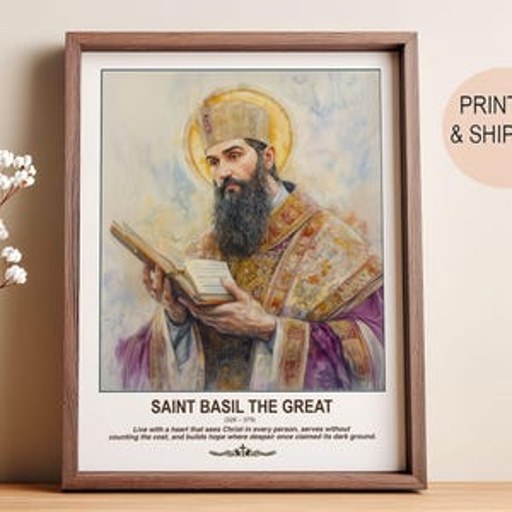
https://www.etsy.com/market/saint_basil_icon
License: unknown
Bishops Basil
Saint- Life Span
- 329 - 379 (age 50)
- Feast Day
- 1 January (Eastern Orthodox); 2 January (Roman Catholic)
- Gender
- male
- Church
- Catholic
Places
Roles & Family
Patronage
monks;hospital administrators;reformers;education;Cappadocia;Russia;the poor
Biography
Saint Basil the Great, also known as Basil of Caesarea, was a fourth-century bishop, theologian, and monastic legislator counted among the Cappadocian Fathers and later among the Three Holy Hierarchs of the Eastern Church. He was born in Caesarea Mazaca, capital of Roman Cappadocia, about 329, into a wealthy and devout Christian household. His father, Basil the Elder, practiced rhetoric and law; his mother, Emmelia, belonged to a family that had suffered in earlier persecutions. His grandmother Macrina the Elder had been a disciple of Gregory Thaumaturgus. Among his brothers and sisters were Macrina the Younger, who guided the family's turn toward asceticism; Gregory, later bishop of Nyssa; Peter, later bishop of Sebaste; and Naucratius, who died young as a hermit. Basil studied in Caesarea, then in Constantinople, and finally at Athens, where he formed a close friendship with Gregory of Nazianzus and encountered the future emperor Julian. After a brief career as a rhetorician he received baptism, gave away a large part of his inheritance, and adopted the monastic life.
In the 350s Basil visited monastic centers in Egypt, Palestine, Syria, and Mesopotamia, then settled on a family property at Annesi on the Iris River in Pontus. There he organized a community of monks and, with Gregory of Nazianzus, compiled an anthology of Origen. His Longer Rules and Shorter Rules set out a cenobitic program of common prayer, work, obedience, and care for the poor that became the principal monastic code of the Greek East. Ordained to the presbyterate by Eusebius of Caesarea, he at first withdrew after a disagreement with his bishop, but returned to help administer the church during famine and doctrinal strife. In 370 he was elected bishop of Caesarea and metropolitan of Cappadocia. Emperor Valens soon divided the province, reducing Basil's civil jurisdiction and prompting a conflict with Anthimus of Tyana; Basil responded in part by consecrating friends, including Gregory of Nazianzus for Sasima and his brother Gregory for Nyssa.
Throughout his episcopate Basil opposed Arian and Homoian theology, insisting on the Nicene confession and on the full divinity of the Holy Spirit. His treatise On the Holy Spirit and his anti-Eunomian writings were major contributions to Trinitarian doctrine in the years before the Council of Constantinople of 381. He established in Caesarea a large charitable complex, remembered as the Basiliad, which included a hospital, hospice, and workshops for the destitute and the sick. He preached homilies on the Hexaemeron and on the Psalms, wrote hundreds of letters that illuminate the church politics of the 370s, and is traditionally associated with the Liturgy of Saint Basil used in the Byzantine rite on a number of solemn days. He sought support from the West, corresponding with Pope Damasus I and with Athanasius of Alexandria, in an effort to restore unity among Nicene bishops.
Basil died in Caesarea on 1 January 379, only a few years before the imperial and conciliar settlement of the Trinitarian controversy. He was commemorated as a saint almost immediately in East and West. The Eastern Orthodox Church keeps his principal feast on 1 January and honors him again on 30 January with Gregory the Theologian and John Chrysostom as the Three Holy Hierarchs. The Roman Catholic Church celebrates him on 2 January, often together with Gregory of Nazianzus, and numbers him among the Doctors of the Church. He is invoked as a patron of monks, of hospital administrators and reformers, of education, and of Cappadocia, and in some traditions of Russia. His monastic rules, dogmatic treatises, homilies, and letters remain central sources for the theology, liturgy, and social ethics of late antique Christianity.