Bishops Maximilian is a saint of the Catholic Church. Bishops Maximilian's feast day is celebrated on 12 October. Bishops Maximilian is the patron saint of Diocese of Linz;Celje.
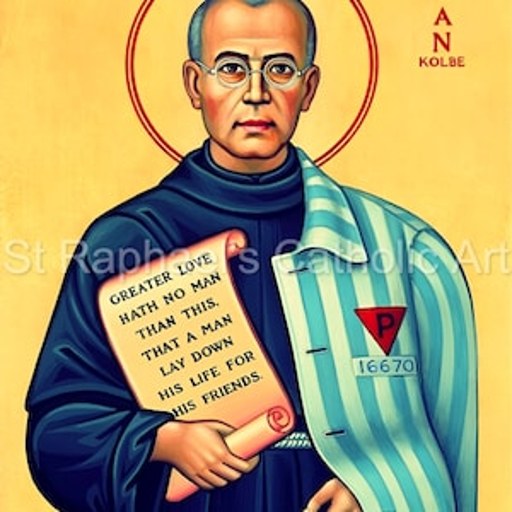
https://www.etsy.com/market/st_maximilian_icon
License: unknown
Bishops Maximilian
Saint- Feast Day
- 12 October
- Gender
- male
- Church
- Catholic
Places
Roles & Family
Patronage
Diocese of Linz;Celje
Canonization
Biography
Saint Maximilian of Celeia, also called Maximilian of Lorch, is a Christian martyr of the later third century who is venerated as an early bishop of the Roman province of Noricum. Later medieval tradition identifies his birthplace as Celeia, a municipium in southeastern Noricum corresponding to modern Celje in Slovenia. No contemporary record preserves the year of his birth, the names of his parents, or any details of his childhood. The surviving accounts of his life were written many centuries after the events they describe and mix local Alpine devotion with the literary conventions of late antique and medieval passiones. In the third century Noricum was a frontier province of the Roman Empire, already touched by Christianity but still largely pagan in its civic cults, and it is in that setting that the memory of Maximilian took shape.
According to the legendary vita, Maximilian was raised as a Christian, undertook a pilgrimage to Rome, and was ordained there before being sent back to evangelize his native region. He is associated in Austrian and Bavarian tradition with the see of Lauriacum (Lorch on the Enns in present-day Upper Austria), an important Roman town on the Danube limes. Whether an organized episcopal church existed at Lauriacum as early as the 270s or 280s is historically uncertain; archaeology and the earliest reliable notices of Norican Christianity do not clearly confirm a third-century bishopric there. It is possible that a local martyr named Maximilian was later given episcopal rank by churches that wished to claim an ancient founder. Slovenian tradition keeps him closely tied to Celeia itself. In either case, the sources agree in presenting him as a missionary preacher rather than as a monk of a later religious order.
The passio relates that during a persecution connected with the emperor Numerian, who reigned briefly in 283–284, Maximilian refused to sacrifice to the gods. He was examined by a prefect whose name is given as Eulasinus or a similar form, confessed the Christian faith, and was beheaded. The liturgical date of the martyrdom is 12 October. The year is variously given in later authors as 281, 284, or 288; the link with Numerian, if it has any historical basis, would point to about 284. Even the place of death is not stable in the tradition: some accounts locate it at Lauriacum, others at Celeia. No acta that can be dated to the third or fourth century survive, so the details of the trial remain legendary. What can be said with more confidence is that a cult of a martyr Maximilian existed in the eastern Alps by the early Middle Ages and that it was strong enough to attract episcopal patronage.
Veneration of Maximilian became important for the medieval churches of Passau, Lorch, and the later Diocese of Linz, which honors him as a principal patron. Passau tradition holds that Bishop Pilgrim translated relics from Lorch to Passau in the late tenth century, in 985. Dedications and relic fragments are found in Upper Austria, Bavaria, and Slovenia, and he is also invoked as a patron of Celje. His feast is kept on 12 October. He was never the subject of a formal papal canonization of the later medieval or modern type; his cult belongs to the ancient, so-called pre-congregation layer of the sanctorale. Because the biographical sources are late and partly contradictory, a careful historian must treat almost every narrative episode as unverified. The enduring fact is the regional cult itself: Alpine Christianity remembered an early witness named Maximilian, ranked him among the bishops of Noricum, and kept his feast through the Middle Ages into the present liturgical calendars of Austria and neighboring lands.