Blandina is a saint of the Catholic Church (d. 177). Blandina's feast day is celebrated on June 2. Blandina is the patron saint of Lyon.
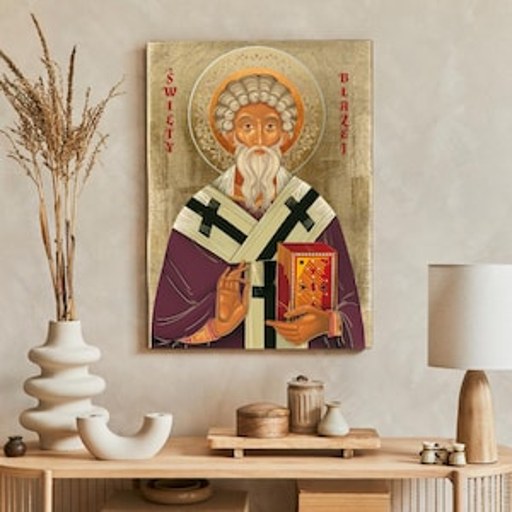
https://etsy.com/market/saint_blandina_icon
License: unknown
Blandina
Saint- Life Span
- d. 177
- Feast Day
- June 2
- Gender
- female
- Church
- Catholic
Places
Roles & Family
Patronage
Lyon
Biography
Saint Blandina was a Christian slave martyred at Lugdunum (modern Lyon) in Roman Gaul in 177, during a local outbreak of persecution in the reign of the emperor Marcus Aurelius. Virtually all that is known of her life and death is contained in a letter written by the surviving Christians of the churches of Vienne and Lugdunum to the churches of Asia and Phrygia; the document was later excerpted at length by Eusebius of Caesarea in Book V of his Ecclesiastical History. Blandina served in the household of a Christian woman who was also arrested. The mistress, aware of her slave's physical frailty, feared that Blandina would not have the strength to remain steadfast. Instead, the letter reports, Blandina was filled with such power that those who tortured her from dawn until evening grew weary and declared themselves unable to invent further cruelties, while she continued to confess, "I am a Christian, and we do nothing wrong."
After the initial interrogations, Blandina was led into the amphitheatre of Lugdunum together with other confessors. She was suspended from a stake in the form of a cross and offered as food to the wild beasts. The animals would not attack her on that occasion. The remaining Christians, seeing her hanging in the shape of a cross and hearing her unceasing prayer, took courage, perceiving in her the image of Christ crucified. She was taken down still alive and returned to prison. On a later day she was brought out once more, this time with a fifteen-year-old boy named Ponticus. Blandina encouraged the youth until he too had completed his martyrdom. She was then the last of the group to be executed. Enclosed in a net, she was thrown to a bull, which tossed her about. When she appeared lifeless, her throat was cut. Even the pagan onlookers, the letter states, acknowledged that never among them had a woman endured so many and such extreme torments.
The bodies of Blandina and her companions were left exposed for several days, guarded so that the Christians could not bury them. They were finally burned and the ashes cast into the river Rhône, the authorities declaring that in this way the martyrs would have no hope of resurrection. The church of Lyon nevertheless preserved their memory. Blandina is commemorated, together with Bishop Pothinus of Lugdunum, the deacon Sanctus, Maturus, Attalus, and the rest of the martyrs of 177, on 2 June. Later hagiographical tradition has honoured her as an example of supernatural fortitude given to one who was, in the world's eyes, the weakest of the company—a slave, a woman, and of delicate constitution.
Her cult remained centred on Lyon, where she has long been counted among the city's principal patrons, although the earliest sources do not record a formal papal decree of patronage or a precise date of canonization; like other pre-Constantinian martyrs she was venerated by popular acclamation and liturgical commemoration from the time of her death.