Blase is a saint of the Catholic Church (d. 316). Blase's feast day is celebrated on 3 February. Blase is the patron saint of throat illnesses;against choking;wild animals;wool combers;carders;veterinarians;physicians;cattle;animals;builders;stonemasons;infants;whooping cough;Dubrovnik;Maratea.
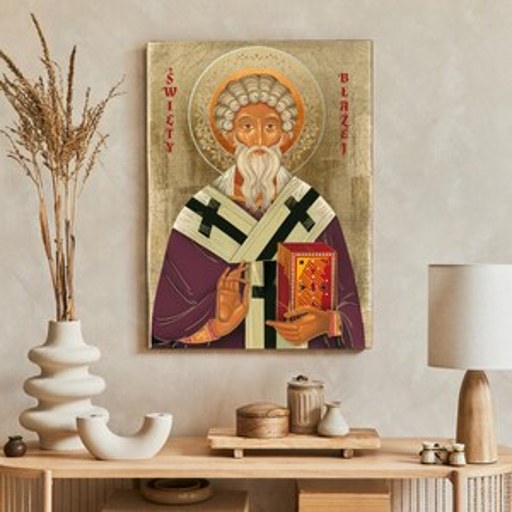
https://www.etsy.com/market/saint_blaise_icon
License: unknown
Blase
Saint- Life Span
- d. 316
- Feast Day
- 3 February
- Gender
- male
- Church
- Catholic
Places
Roles & Family
Patronage
throat illnesses;against choking;wild animals;wool combers;carders;veterinarians;physicians;cattle;animals;builders;stonemasons;infants;whooping cough;Dubrovnik;Maratea
Canonization
Biography
Saint Blaise (Latin Blasius; also Blase) was a physician and bishop of Sebastea in Armenia Minor, in the eastern Roman Empire, corresponding to modern Sivas in Turkey. The traditional accounts, which took shape centuries after his death, present him as a healer of both people and animals who was chosen bishop of that city. During the persecution of Christians in the East under the emperor Licinius, conventionally placed around 316, he withdrew from Sebastea to a cave in the wilderness, where wild beasts are said to have gathered around him without harming him and to have received his care.
Hunters sent by the local governor discovered him and brought him back for trial. On the way, according to the legend that later defined his principal patronage, a woman presented a boy who was choking on a fish bone; Blaise prayed over the child and the bone was dislodged. He likewise commanded a wolf to restore a pig it had seized from a poor widow. Refusing to offer sacrifice to the imperial gods, he was scourged and had his flesh raked with iron combs of the kind used in wool-working, after which he was beheaded. The iron combs became his usual iconographic attribute, together with crossed candles.
Little of this narrative can be verified by contemporary documents. References to a martyr-bishop Blaise of Sebastea appear in later martyrologies, medical writings, and liturgical books from the fifth and sixth centuries onward; the full Acts are legendary in character. His cult, however, is ancient and became one of the most popular in medieval Europe. In the Roman Catholic Church his feast is kept on 3 February; the Eastern Orthodox Churches commemorate him on 11 February. He was numbered among the Fourteen Holy Helpers, saints invoked especially in time of disease. From the late Middle Ages the Blessing of the Throats, given with two crossed candles on his feast, has been a widespread Catholic devotion.
Relics attributed to Saint Blaise were carried westward. Dubrovnik (Ragusa) took him as its chief patron after a tenth-century legend in which he warned the city of an impending attack; his church and statue remain central to the city’s identity. The basilica of San Biagio at Maratea in southern Italy also claims his remains. He is invoked against diseases of the throat and against choking, and is regarded as patron of wild animals, veterinarians, wool-combers and related textile workers, cattle, and many towns and crafts.