Blessed Margaret of Savoy is a blessed of the Catholic Church (d. 1464). Blessed Margaret of Savoy's feast day is celebrated on 23 November.
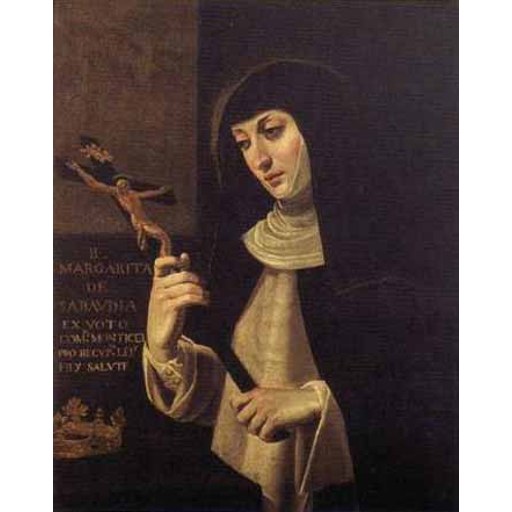
Unidentified painter
License: Public domain
Blessed Margaret of Savoy
Blessed- Life Span
- d. 1464
- Feast Day
- 23 November
- Gender
- female
- Church
- Catholic
Places
Roles & Family
Religious Information
Canonization
Biography
Blessed Margaret of Savoy was a noblewoman of the House of Savoy who lived in northwestern Italy in the late fourteenth and fifteenth centuries. She was born at Pinerolo in Piedmont, the daughter of Amadeus of Savoy, Prince of Achaea and lord of Piedmont, and of Catherine of Geneva. Reliable sources disagree on the year of her birth, some giving 1382 and others 1390; the date cannot be fixed with certainty. She belonged to the Savoy-Achaea cadet line that held Piedmont under the wider Savoyard dynasty. Almost nothing independent of later pious biography survives about her childhood, beyond her rank and the fact that daughters of her house were customarily used to seal regional alliances.
In the early fifteenth century she was married to Theodore II Palaiologos, Marquess of Montferrat, a ruler of Byzantine imperial descent who held the Italian marquisate of Montferrat. Theodore was a widower and much older than Margaret. The match bound Savoy to Montferrat. He already had children from an earlier marriage, among them his heir John Jacob; Margaret herself had no children. She lived as marchioness at the Montferrat court until Theodore died in 1418. After she was widowed, later accounts say that further marriages were proposed for her and that she refused them, choosing instead a life of religion and charity. That refusal is a common hagiographical motif and should be treated with caution, but her subsequent widowhood and religious profession are not in doubt.
Margaret entered the Third Order of Saint Dominic and devoted her remaining means to the poor and the sick. In Alba, in the Montferrat lands, she founded a house of Dominican women, generally identified as the monastery of Santa Maria Maddalena, and took up residence there under religious rule. The foundation is placed in the mid-fifteenth century. She is described in the tradition as austere, given to prayer and the sacraments, and active in works of mercy, though the inner details of that portrait come mainly from later Dominican and local lives rather than from contemporary administrative records. Her career is that of a high-born widow of the Italian Renaissance courts who used status and property to establish a stable religious community.
She died at Alba on 23 November 1464 and was buried in the church of the community she had established. A local cult formed around her tomb in Piedmont. In the seventeenth century the Holy See confirmed that cult; she is venerated as Blessed Margaret of Savoy, with liturgical commemoration on 23 November, especially among Dominicans and in the region of Alba and Savoy. She was never canonized and remains a beata. The outline of her life—Savoyard birth at Pinerolo, marriage to the Palaiologos marquess of Montferrat, childless widowhood, Dominican tertiary profession, monastic foundation at Alba, and death there in 1464—is historically secure; claims about visions, miracles in life, or precise motives depend on later hagiography and are less certain.