Bogumilus is a blessed of the Catholic Church. Bogumilus's feast day is celebrated on 10 June. Bogumilus is the patron saint of Uniejów;Archdiocese of Gniezno.
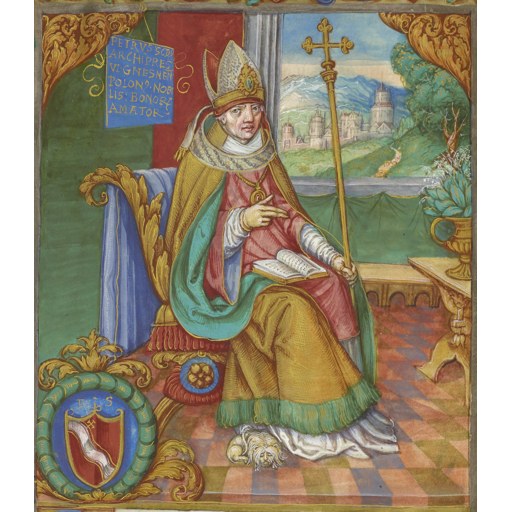
Stanisław Samostrzelnik
License: Public domain
Bogumilus
Blessed- Feast Day
- 10 June
- Gender
- male
- Church
- Catholic
Places
Roles & Family
Patronage
Uniejów;Archdiocese of Gniezno
Canonization
Biography
Bogumilus, known in Polish as Bogumił and sometimes called Bogomil or Bogumił of Dobrów, was a twelfth-century prelate of the Polish Church who is remembered as Archbishop of Gniezno and later as a hermit. Traditional accounts, which rest largely on later hagiography rather than contemporary charters, place his birth in Koźmin in Greater Poland, into a family of the local nobility. He is said to have been one of twins; his brother, known as Boguphalus or Bogufał, is reported in the same tradition to have become bishop of Poznań. Bogumilus received his early formation at the cathedral school of Gniezno, the primatial church of Poland, and is described as having pursued further studies in Paris, which in the twelfth century attracted many Central European clerics seeking training in theology and canon law.
After ordination he served as a priest in Greater Poland, including pastoral work associated with Koło in some accounts, and rose to become chancellor or provost of the Gniezno cathedral chapter. In the later twelfth century he was named Archbishop of Gniezno. Hagiographic sources present him as a reforming archbishop who sought to restore clerical discipline, especially the observance of celibacy, and who lived with notable personal austerity. The Polish lands at that time were politically fragmented among the Piast dukes after the testament of Bolesław III, and relations between the metropolitan see and both the secular rulers and the local clergy were often strained. Tradition holds that opposition to his reforms, together with these political tensions, led Bogumilus to resign the archbishopric after a relatively short tenure.
He then withdrew from public office to a hermitage at Dobrów, near Uniejów in the Łęczyca region, where he spent his remaining years in eremitical solitude, prayer, and penance. He was not, on the evidence that survives, a professed member of a religious order, though later writers sometimes associated him with eremitical communities. The date of his death is given as 10 June; the year is recorded variously as 1182 or 1204, and historians note that the identification of the hermit of Dobrów with a particular named archbishop of Gniezno is not beyond dispute, because the medieval catalogues of bishops and the later vitae do not align perfectly. He was buried in the collegiate church of Uniejów, dedicated to the Assumption of the Blessed Virgin Mary, which became the center of his cult.
A local devotion grew around his tomb in the later Middle Ages and early modern period. In 1925 Pope Pius XI confirmed the ancient cult of Bogumilus, an act of confirmatio cultus that authorized his public veneration as Blessed in the Archdiocese of Gniezno. His feast day is observed on 10 June. He is honored as a patron of the town of Uniejów and is associated with the Archdiocese of Gniezno. Because so little contemporary documentation survives, the details of his career remain partly legendary; what can be said with confidence is that a reforming metropolitan of Gniezno who ended his life as a hermit in the Łęczyca countryside became the object of a durable regional cult that the Holy See eventually recognized.