Bonfilius is a saint of the Catholic Church (d. 1115). Bonfilius's feast day is celebrated on 27 September.
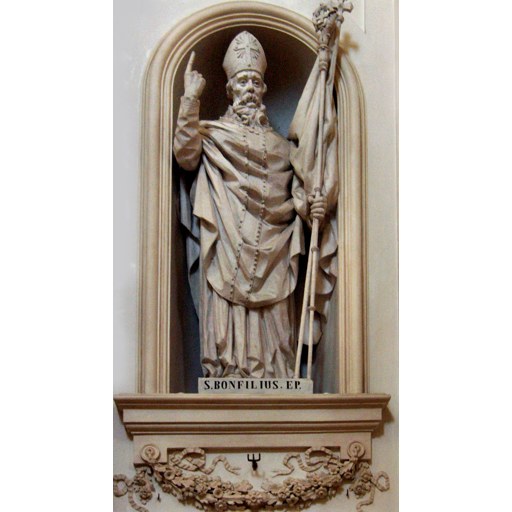
Georges Jansoone (JoJan)
License: CC BY-SA 3.0
Bonfilius
Saint- Life Span
- d. 1115
- Feast Day
- 27 September
- Gender
- male
- Church
- Catholic
Places
Roles & Family
Religious Information
Biography
Bonfilius, known in Italian as Bonfiglio or Bonfilio, was a Benedictine monk, abbot, and bishop in central Italy in the later eleventh and early twelfth centuries. He was born in Osimo, in the Marche of Ancona. Drawn to the monastic life, he entered the Benedictine community of Santa Maria di Storaco, an abbey in the rural territory of Foligno in Umbria. There he followed the Rule of Saint Benedict and in time was elected abbot, combining spiritual direction of the monks with the temporal administration of the house and its dependencies.
In 1078, in the midst of the Gregorian Reform, he was appointed bishop of Foligno. As diocesan bishop he is remembered for efforts to restore clerical discipline, to protect ecclesiastical liberty against lay interference, and to sustain the pastoral and liturgical life of the see. After some eighteen years in office he left Foligno around 1096 to make a pilgrimage to the Holy Land, in the same period in which the First Crusade was preached. Medieval notices present him primarily as a pilgrim rather than as a military participant; he remained in Palestine for a number of years, living a life of prayer in and around Jerusalem.
He returned to Italy about 1104. He did not resume government of the church of Foligno, whether because another prelate had been installed in his long absence or because he himself chose to resign. He withdrew again to Santa Maria di Storaco and there adopted a more strictly eremitical form of monastic life, joining solitude to the communal observance of the abbey. He died at the monastery on 27 September 1115.
A local cult grew around his memory in Foligno and Osimo. He is entered in the Roman Martyrology on 27 September and has continued to be venerated as a saint of the diocese of Foligno. Little of a strictly documentary character survives concerning his inner life or particular miracles. The outline of his career—monk and abbot, reforming bishop, pilgrim to Jerusalem, and finally hermit—belongs to a recognizable pattern among Italian churchmen of the Gregorian age who combined public office with a persistent attraction to the desert and the holy places. Later hagiographers added conventional wonders, but the essential facts of his origin in Osimo, his Benedictine profession, his episcopate at Foligno, his eastern pilgrimage, and his death in 1115 rest on medieval liturgical and local historical tradition.