Bonosus of Trier is a saint of the Catholic Church (d. 373). Bonosus of Trier's feast day is celebrated on 17 February.
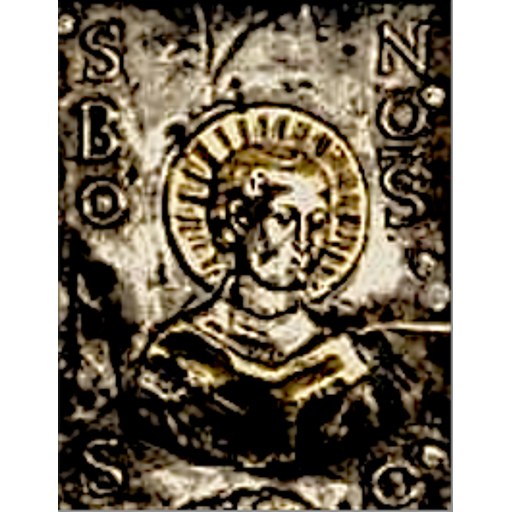
Der Name des Autors ist nicht bekannt.
License: Public domain
Bonosus of Trier
Saint- Life Span
- d. 373
- Feast Day
- 17 February
- Gender
- male
- Church
- Catholic
Places
Roles & Family
Biography
Bonosus of Trier was a fourth-century bishop of Trier (Latin: Augusta Treverorum), then one of the foremost cities of the western Roman Empire and a frequent imperial residence in the province of Belgica Prima, in what is now western Germany. He belongs to the poorly documented middle stretch of the Trier episcopal list, between the well-known anti-Arian bishops Saint Maximinus and Saint Paulinus and the later fourth-century bishop Britto. Almost nothing is recorded of his origins, family, education, or career before he became bishop. He enters the historical tradition only as Paulinus’s successor and as a representative of Nicene orthodoxy at a time when the Arian controversy still divided the churches of the empire and repeatedly involved the imperial court.
Paulinus of Trier had been banished by the Emperor Constantius II, who favored Arian or homoian theology, and died in exile in Phrygia in 358. Bonosus was then chosen to occupy the see, probably in 358 or 359. Later catalogues of the bishops of Trier place his pontificate between Paulinus and Britto (also called Brittonius). Like Maximinus, who had received Saint Athanasius of Alexandria at Trier, and like Paulinus, Bonosus is remembered as a defender of the Nicene faith. No letters, sermons, synodal acts, or contemporary narrative accounts of his administration survive, so particular deeds, miracles, or conflicts cannot be described from primary evidence. His significance in the tradition of the church of Trier rests on his place in that orthodox succession during decades when imperial policy in the West was not consistently aligned with Nicaea.
His death is generally dated to 373. He was succeeded by Britto, who was bishop of Trier by the early 380s and took part in the ecclesiastical assemblies of that period, when Theodosius I moved to restore Nicene orthodoxy as the public doctrine of the empire. Bonosus’s years as bishop therefore fall across the later reign of Constantius II, the brief rules of Julian and Jovian, and the reign of Valentinian I, who from 367 used Trier as a principal residence. No specific dealings between Bonosus and the imperial court are documented. Because the sources are so meagre, even the exact year of his death is traditional rather than independently corroborated by a contemporary chronicle, but 373 is the date given in the standard episcopal lists.
Bonosus is venerated as a saint in the Catholic Church and in the Eastern Orthodox Church. His feast is kept on 17 February. There is no reliable evidence that he belonged to a monastic or other religious order, and nothing is known of a spouse or children. He was neither pope nor patriarch. His cult has remained essentially local, tied to the ancient church of Trier, and he is not widely invoked as patron of particular places, professions, illnesses, or groups. No certain information survives about the site of his burial. The extreme poverty of the record means that any fuller biography would be conjecture; what can be said with confidence is limited to his office, his place in the Nicene succession at Trier, the approximate dates of his episcopate, and his later liturgical commemoration.