Bridget of Sweden is a saint of the Catholic Church (1303 - 1373). Bridget of Sweden's feast day is celebrated on 23 July. Bridget of Sweden is the patron saint of Europe;Sweden;widows.
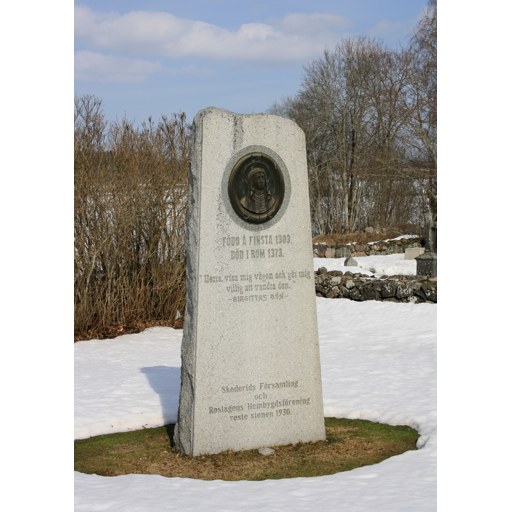
Janders
License: Public domain
Bridget of Sweden
Saint- Life Span
- 1303 - 1373 (age 70)
- Feast Day
- 23 July
- Gender
- female
- Church
- Catholic
Places
Relics & Where to Venerate
Location unknown
The bodily remains of Bridget of Sweden are a first-class relic. Venerated at Vadstena Abbey.
Location unknown
An hour away from this monastery, the Vadstena Abbey (Evangelical-Lutheran), also known as the Blue Church, contains relics of the saint, and her body is venerated by Lutheran and Catholic believers
Location unknown
An hour away from this monastery, the Vadstena Abbey (Evangelical-Lutheran), also known as the Blue Church, contains relics of the saint, and her body is venerated by Lutheran and Catholic believers
Roles & Family
Religious Information
Patronage
Europe;Sweden;widows
Canonization
Biography
Bridget of Sweden, known in her own language as Birgitta Birgersdotter, was born in 1303 at the family estate of Finsta in the province of Uppland. Her father, Birger Persson, was lawspeaker of Uppland and one of the wealthiest and most influential nobles in the Swedish kingdom; her mother, Ingeborg Bengtsdotter, belonged to the Folkunga family and thus to the same wider kindred as the ruling dynasty. Bridget’s early years were those of a high-born girl in fourteenth-century Scandinavia. After her mother’s death she was placed for a time with an aunt. In her early teens she was married to Ulf Gudmarsson, a knight of comparable standing who later became lawspeaker of Närke. The marriage, which lasted about twenty-eight years, was by contemporary accounts a harmonious one. The couple made their principal home at Ulvåsa in Östergötland and had eight children. Among them were Märta, who married into the high nobility; Karl; Birger; and Katarina, who accompanied her mother in later years and is herself venerated as Saint Catherine of Sweden.
While managing a large household Bridget cultivated a life of prayer, fasting, and charity to the poor and sick. She and Ulf undertook the long pilgrimage to the shrine of Saint James at Santiago de Compostela. On their return Ulf fell ill and died in 1344 at the Cistercian abbey of Alvastra. Bridget then took up residence in a house near that monastery. It was in this period of widowhood that she experienced the first of the visions that would define her public role. She understood these revelations as coming from Christ, the Virgin Mary, and various saints, and she dictated them to confessors who rendered them into Latin. The resulting collection, the Revelationes, mixed intimate spiritual teaching with denunciations of clerical corruption, royal injustice, and the prolonged residence of the popes at Avignon. Bridget also believed she had received a rule for a new order dedicated to the Saviour, providing for a double community of sixty nuns and twenty-five monks under the authority of an abbess.
With the support of King Magnus Eriksson she obtained the royal estate at Vadstena as the site of this foundation. Although the monastery was not fully established until after her death, the project occupied her remaining years. In 1349 she left Sweden for Rome in order to obtain papal confirmation of the rule and to live as a pilgrim near the tombs of Peter and Paul. She remained based in Rome for the rest of her life, gathering a small circle of followers that included her daughter Katarina and the Spanish hermit Alfonso of Jaén, who later edited her revelations. Bridget repeatedly exhorted successive popes to return to Rome and to reform the Church. She also addressed letters and messages to the kings of Sweden, France, and Cyprus, and to Queen Joanna of Naples. In 1370 Pope Urban V approved her rule. In 1372 she made a pilgrimage to the Holy Land, visiting the sites of the Passion; she returned to Rome in weakened health.
Bridget died in Rome on 23 July 1373. Her body was first buried at the church of San Lorenzo in Panisperna; in the following year her daughter Katarina escorted the relics to Vadstena, where they were enshrined in the abbey church. The Bridgettine Order spread in the later Middle Ages to several countries, though it was largely suppressed in Scandinavia at the Reformation. Bridget was canonized by Pope Boniface IX on 7 October 1391, only eighteen years after her death. Her feast, long kept on 8 October, is now observed on 23 July in the General Roman Calendar. In 1999 Pope John Paul II declared her a co-patron saint of Europe, together with Catherine of Siena and Teresa Benedicta of the Cross (Edith Stein). She is also honoured as a patron of Sweden and of widows. Her Revelations continued to be read widely in the fifteenth century and influenced both private devotion and discussions of church reform.