Brioc is a saint of the Catholic Church. Brioc's feast day is celebrated on 1 May. Brioc is the patron saint of Saint-Brieuc;Diocese of Saint-Brieuc;St Breock.
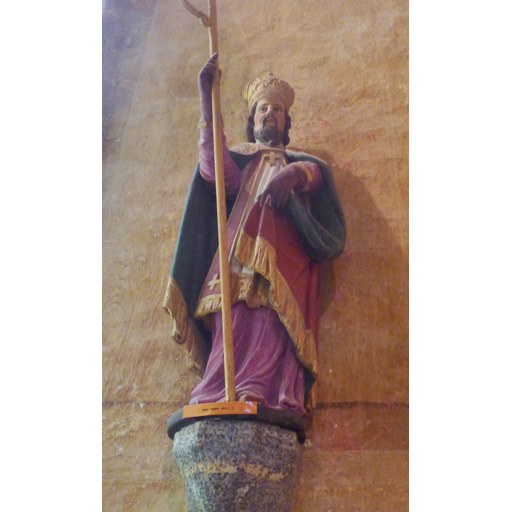
Moreau.henri
License: CC BY-SA 4.0
Brioc
Saint- Feast Day
- 1 May
- Gender
- male
- Church
- Catholic
Places
Roles & Family
Patronage
Saint-Brieuc;Diocese of Saint-Brieuc;St Breock
Biography
Saint Brioc (also known as Brieuc, Briog, Briocus, and Breock) was a Welsh-born monastic founder and missionary of the fifth and early sixth centuries, venerated as one of the seven founding saints of Brittany. According to an eleventh-century Latin vita, he was born in the kingdom of Ceredigion in western Britain (present-day Cardiganshire, Wales). His father, named Cerpus or Cerp, is described as a pagan of some standing; his mother, Eldrude or Eldruda, was a Christian who had the child baptized and instructed in the faith. The same legendary life associates his education with Saint Germanus of Auxerre, a connection that, if historical, would place Brioc’s youth in the second quarter of the fifth century. Modern historians generally treat the Germanus episode as a conventional hagiographical motif rather than a securely documented fact, since the surviving Life was written some five centuries after the period it describes and independent contemporary evidence is lacking.
After a period of study and ascetic training on the Continent, Brioc is said to have returned to Britain, where he converted members of his own family and worked as a preacher. He subsequently crossed to Armorica (Brittany) with a band of companions. Tradition places his landing on the northern coast, in the area of the Gouet estuary. There he established a monastic community that became the nucleus of the later town and episcopal see of Saint-Brieuc in what is now the department of Côtes-d’Armor. In Breton hagiography he ranks with Samson of Dol, Malo, Paul Aurelian, Tudwal, Padarn, and Corentin as one of the seven saints credited with organizing the early church in Brittany. Whether he himself exercised episcopal office is uncertain. Later medieval writers sometimes styled him a bishop, but the diocese of Saint-Brieuc was not formally constituted until centuries after his death, and the earliest stratum of the tradition presents him primarily as an abbot and missionary rather than as a diocesan bishop.
The date of his death is not recorded in contemporary sources. Later tradition commonly assigns it to about 502, at his monastery in Brittany, but that year is conventional rather than documented. He was buried at the site of his foundation. In the ninth century, during Viking raids on the Breton coasts, his relics were translated for safety to the abbey of Saint-Serge at Angers; portions were later returned to Saint-Brieuc, where they remain associated with the cathedral. A cult also developed in Cornwall, where the parish of St Breock preserves his name. His principal feast is kept on 1 May. He is the patron saint of the city and diocese of Saint-Brieuc. He was never the subject of a formal papal canonization of the later medieval or modern type; his sainthood belongs to the ancient, pre-congregational cultus of the Celtic and Frankish churches.
Because the principal vita was composed long after the events it narrates, and because fifth- and sixth-century documentation for individual British and Breton churchmen is extremely sparse, many details of Brioc’s career—his exact dates, his studies under Germanus, and the miracle stories attached to him—cannot be verified historically. What can be said with reasonable confidence is that a British monastic founder named Brioc was remembered as the origin of the church of Saint-Brieuc, that his cult was well established in Brittany and in parts of southwestern Britain by the central Middle Ages, and that he belongs to the broader movement of British emigration and monastic mission into Armorica in the post-Roman centuries.