Bruno of Cologne is a saint of the Catholic Church (d. 1101). Bruno of Cologne's feast day is celebrated on 6 October. Bruno of Cologne is the patron saint of Calabria;Carthusian Order;people possessed by demons.
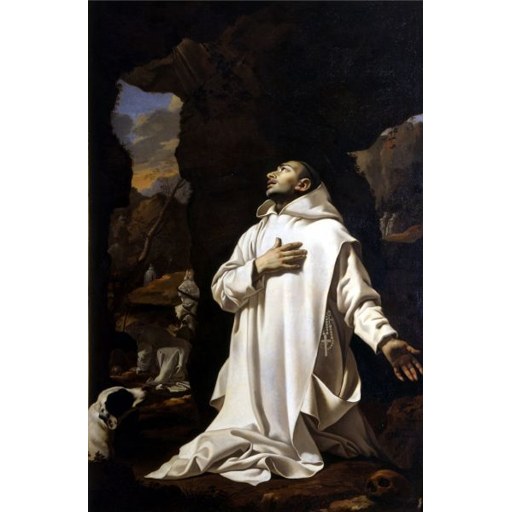
Nicolas Mignard
License: Public domain
Bruno of Cologne
Saint- Life Span
- d. 1101
- Feast Day
- 6 October
- Gender
- male
- Church
- Catholic
Places
Relics & Where to Venerate
Location unknown
1030 Cologne , Archdiocese of Cologne Died 6 October 1101 Serra San Bruno Venerated in Catholic Church Beatified 1514 by Pope Leo X [ 1 ] Canonized 17 February 1623 by Pope Gregory XV [ 2 ] Feast 6 October Attributes Carthusian habit , holding a skull , rule of the Carthusian order, crucifix Bruno of Cologne OCart ( German : Bruno von Köln ; Italian : Bruno di Colonia ; c
Roles & Family
Religious Information
Patronage
Calabria;Carthusian Order;people possessed by demons
Canonization
Biography
Bruno of Cologne was a German priest, teacher, and monastic founder of the late eleventh century, remembered as the originator of the Carthusian Order. He was born in Cologne, in the German kingdom of the Holy Roman Empire, around 1030, into a family of local standing. After early schooling in his native city he studied at the cathedral school of Reims, then among the leading centres of learning in northern Europe. He served for a time as a canon of Saint Cunibert in Cologne before returning to Reims, where he taught the sacred sciences and the liberal arts and, from the mid-eleventh century, held the office of chancellor of the archdiocese. His pupils included Odo of Châtillon, later Pope Urban II. Contemporary reputation credited him with learning, personal austerity, and a firm stance against simony and other abuses in the clergy.
In the 1070s Bruno joined other Reims clergy in resisting Archbishop Manasses I, whose tenure was widely condemned as simoniacal. After Manasses was finally removed, Bruno was mentioned as a possible archbishop of Reims but refused the see. By about 1080 he had determined to leave the schools and the secular ecclesiastical career for solitude. He spent a brief period with Robert of Molesme, but he sought a more strictly eremitical life than that community then provided. In 1084, with six companions, he presented himself to Hugh of Châteauneuf, bishop of Grenoble. Hugh assigned them a remote valley in the Chartreuse massif. There they built separate wooden cells and a small oratory and began the pattern that defined the Carthusians: hermits living in individual cells, gathering for the night office and conventual Mass, bound by vows, silence, poverty, and manual work, under a prior. That settlement became the Grande Chartreuse, mother house of the order.
In 1090 Urban II, Bruno's former pupil, summoned him to Rome as an adviser during a period of Gregorian reform and conflict with the imperial party. Bruno obeyed and left the Alpine community under a prior. In Italy he declined the archbishopric of Reggio in Calabria. With papal permission he withdrew again into the wilderness. Count Roger I of Sicily granted him a tract in the wooded mountains of Calabria, in the Serre. About 1091 Bruno established a second hermitage, Santa Maria della Torre, at the site later associated with the town of Serra San Bruno. He spent his remaining years there, governing his brethren, remaining in correspondence with the Chartreuse, and composing a profession of faith and letters that survive; commentaries on the Psalms and on the Pauline epistles have also been attributed to him, though the extent of his authorship of the latter has been debated. He died at the Calabrian hermitage on 6 October 1101 and was buried there.
Bruno was never the subject of a formal papal canonization of the later juridical type. In 1514 Pope Leo X allowed the Carthusians to keep his liturgical feast; in 1623 Pope Gregory XV extended the celebration to the Latin Church. His feast is 6 October. He is venerated as founder and patron of the Carthusian Order and as a patron of Calabria, and he has been invoked for those believed to be possessed. Relics associated with him are kept at the Charterhouse of Serra San Bruno. The order he founded, notable for combining solitude with choral liturgy and for resisting later mitigations of its rule, spread in the twelfth century and after, and it continues to exist.