Cadoc is a saint of the Catholic Church. Cadoc's feast day is celebrated on 24 January. Cadoc is the patron saint of Llancarfan;Glamorgan.
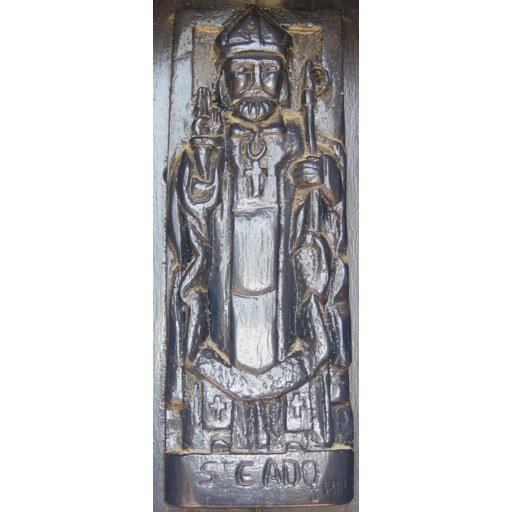
License: CC BY-SA 3.0
Cadoc
Saint- Feast Day
- 24 January
- Gender
- male
- Church
- Catholic
Places
Roles & Family
Patronage
Llancarfan;Glamorgan
Biography
Cadoc (also known as Cadog, Cattwg, or in Latin Cadocus) was a Welsh abbot, teacher, and monastic founder active in the fifth and sixth centuries, and one of the principal saints of early medieval southeast Wales. The chief narrative source for his life is the Vita Sancti Cadoci, written about the year 1100 by Lifris, a member of the clerical community at Llancarfan. According to that text, Cadoc was the son of Gwynllyw, ruler of Gwynllwg (the coastal lordship later associated with Newport and the Wentloog levels), and of Gwladys, a daughter of Brychan of Brycheiniog. Both parents were themselves later honoured as saints; Gwynllyw is the Saint Woolos to whom Newport's cathedral is dedicated. The vita's opening chapters, which describe Gwynllyw's violent abduction of Gwladys, a subsequent conversion, and miraculous signs surrounding Cadoc's birth, belong to the stock of hagiographical legend and cannot be treated as contemporary history. The genealogical connection to the dynasties of Gwynllwg and Brycheiniog does, however, match the later distribution of Cadoc's cult.
Medieval tradition holds that Cadoc was educated first by Irish monks, including a period at Caerwent under Tatheus (Tathyw), and that he also studied in the school associated with Saint Illtud at Llanilltud Fawr (Llantwit Major) before travelling to Ireland for further instruction. His great foundation was the monastery of Llancarfan (Nant Carfan) in the Vale of Glamorgan, which became a major centre of learning and pastoral influence in the Welsh church. The community observed the customs of Celtic monasticism rather than a later Benedictine or other continental rule. A large number of churches in Glamorgan, Gwent, and neighbouring regions were dedicated to Cadoc or claimed him as founder, among them the sites later called Cadoxton (Tregatwg) and Llangadog. His cult travelled with British emigration to Cornwall and especially to Brittany, where he is venerated as Saint Cado; the island chapel of Saint-Cado in Morbihan is a well-known focus of that devotion.
The vita and related medieval texts surround Cadoc with miracle stories, healings, and confrontations with kings. One frequently cited episode involves a legal dispute over cattle in which King Arthur appears as a somewhat grasping ruler whom Cadoc and his community outmanoeuvre; the passage is among the earlier narrative references to Arthur in Welsh Latin literature, though it reflects twelfth-century storytelling as much as any sixth-century event. Cadoc is also presented as a teacher of other saints. Irish tradition sometimes links him with Finnian of Clonard, but the chronology of such connections is uncertain and may arise from later attempts to associate famous names. Taken together, these stories illustrate the prestige that Llancarfan claimed in the eleventh and twelfth centuries; they are not a reliable chronicle of Cadoc's own lifetime.
Accounts of his death are contradictory and largely legendary. Lifris relates that Cadoc was borne away on a white cloud to Beneventum, where he became bishop and was martyred by Saxons while celebrating Mass. Beneventum has been identified by different writers with Benevento in southern Italy and with British places such as Weedon in Northamptonshire; neither identification is historically secure, and modern scholars generally regard the martyrdom as a literary invention. It is more probable that Cadoc died in Wales, conceivably at Llancarfan, at an unknown date in the sixth century. He was venerated as a saint long before the development of papal canonization, and his feast is observed on 24 January in Western calendars. His cult remained especially strong in Glamorgan and at Llancarfan, and churches dedicated to him survive in Wales, Cornwall, and Brittany.