Caius is a saint of the Catholic Church (d. 296). Caius's feast day is celebrated on 22 April.
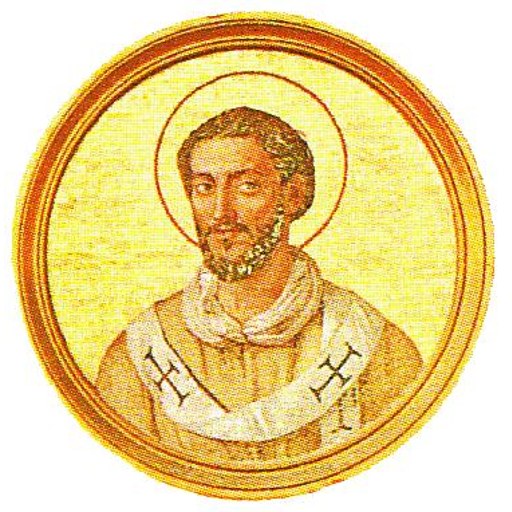
User Känsterle on nl.wikipedia
License: Public domain
Caius
Saint- Life Span
- d. 296
- Feast Day
- 22 April
- Gender
- male
- Church
- Catholic
Places
Relics & Where to Venerate
Location unknown
The bodily remains of Caius are a first-class relic. Venerated at Catacomb of Callixtus.
Roles & Family
Biography
Caius, also known in Latin as Gaius, was Bishop of Rome from 17 December 283 until his death in 296, and is reckoned the twenty-eighth pope in the traditional list of the bishops of Rome. He succeeded Pope Eutychian and was succeeded by Pope Marcellinus. The dates and duration of his pontificate rest principally on the Liberian Catalogue, a papal list compiled in Rome around 354, which assigns him twelve years, four months, and seven days in office. Beyond these chronological notices, almost nothing about his life can be established from contemporary evidence. He belongs to a stretch of third-century papal history for which narrative sources are late, sparse, and often legendary.
According to the Liber Pontificalis, a collection of papal biographies assembled in the sixth century, Caius was a Dalmatian by birth and a relative of the Emperor Diocletian. Later writers identified his birthplace as Salona, the principal city of Roman Dalmatia, near present-day Split in Croatia. Modern historians regard the kinship with Diocletian as legendary and treat the Dalmatian origin as unverified tradition rather than documented fact. No inscription, imperial record, or third-century Christian writer supplies independent confirmation of his family or native city. His year of birth is unknown.
The years of his episcopate coincided with the early reign of Diocletian, who became emperor in 284, and with a relatively quiet interval for the Church in the capital. The Great Persecution did not begin until 303, after Caius had died. The Liber Pontificalis ascribes to him regulations on the cursus honorum of the clergy, requiring that a candidate for the episcopate pass through the grades of ostiary, lector, exorcist, acolyte, subdeacon, deacon, and priest, and it records that he ordained twenty-five priests, eight deacons, and five bishops. Scholars generally consider these decrees anachronistic projections of later Roman church order. A separate legendary cycle, the Acts of Saint Susanna, makes Caius the uncle of the Roman martyr Susanna and the brother of the priest Gabinius, and associates him with the house that later became the church of Santa Susanna on the Quirinal; that narrative is regarded as fictitious. In historical terms, his pontificate is best understood as a period in which the Roman Christian community continued its worship, charity, and catacomb burials under a legal status that was still tolerated, though socially insecure.
Tradition gives the date of his death as 22 April 296. Later martyrologies styled him a martyr, but that title is difficult to sustain: the empire-wide persecution under Diocletian and Galerius had not yet been launched, and Eusebius of Caesarea, writing in the early fourth century, does not include him among the martyrs. He was interred in the Catacomb of Callixtus on the Via Appia. In the nineteenth century Giovanni Battista de Rossi identified, in that cemetery, a papal crypt chamber and inscriptional fragments bearing the name CAIVS together with an episcopal designation, which are accepted as marking the tomb of this pope. A church in his honor, San Caio, was built in Rome in 1631 near the Baths of Diocletian and was demolished in 1880.
Caius has been venerated as a saint in the Roman Church from an early period, by liturgical commemoration rather than by a later formal process of canonization. His feast day is 22 April. He appeared in the General Roman Calendar until the reform of 1969, when his feast was dropped from the universal calendar because so little about him can be known with certainty; he is still named in the Roman Martyrology on that date. No historically secure list of patronages is attached to him. The combination of a firm place in the papal succession, a documented tomb in the Callixtus catacomb, and an almost complete absence of reliable personal detail is characteristic of several bishops of Rome in the later third century.