Carantoc is a saint of the Catholic Church. Carantoc's feast day is celebrated on 16 May. Carantoc is the patron saint of Llangrannog;Crantock;Carhampton;Carantec.
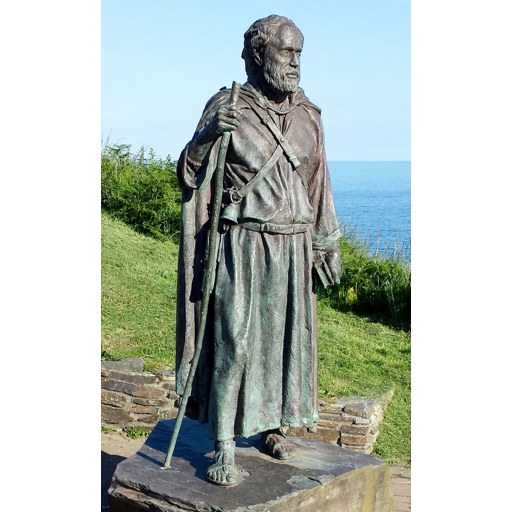
DeFacto
License: CC BY-SA 4.0
Carantoc
Saint- Feast Day
- 16 May
- Gender
- male
- Church
- Catholic
Places
Roles & Family
Patronage
Llangrannog;Crantock;Carhampton;Carantec
Biography
Saint Carannog, also known as Carantoc, Carantocus, and Carantog, was a Welsh monastic founder, abbot, and missionary of the sixth century, commemorated as a saint in Wales, Cornwall, Somerset, and Brittany. Contemporary records of his life do not survive. The principal narrative source is a Latin Life, the Vita Sancti Carantoci, preserved in the British Library manuscript Cotton Vespasian A.xiv, a collection of Welsh saints' lives copied in the late twelfth or early thirteenth century. That text, together with Welsh genealogical tracts such as Bonedd y Saint, presents him as a member of the royal kindred of Ceredigion and, in the vita, as a son of Ceredig, the ruler from whom the kingdom took its name and who was himself counted among the sons of Cunedda. No early source gives a year of birth or of death; later dates sometimes found in popular works are modern estimates and cannot be verified.
According to the vita, Carannog declined the succession to his father's kingdom in order to follow a religious vocation. He withdrew from court, lived as a hermit, and undertook missionary journeys, including travel by sea with a portable altar, a motif familiar in Celtic hagiography. The most frequently retold episode of the Life is set at Carrum, identified with Carhampton in Somerset. There, King Arthur and the local ruler Cador were confronted by a dragon that devastated the countryside. Carannog's altar had floated to that shore; after he recovered it, he tamed the dragon with his stole and led it away. Arthur then granted him land on which to found a church. The story is legendary in character and is one of a number of hagiographical texts that introduce Arthur as a local king or warrior rather than as a pan-British emperor. It cannot be treated as historical evidence for either Carannog or Arthur, but it does show that by the time the Life was written the saint's cult was established in Somerset as well as in Wales.
The geographical spread of dedications is the most concrete trace of his cult. In Ceredigion the village and parish of Llangrannog take their name from him; the church of Saint Carannog stands there, and local tradition associates a coastal cave and a holy well with his hermitage. Legend at Llangrannog relates that a dove indicated the place where the church should be built. In Cornwall the former collegiate church of Crantock, whose name derives from Carantoc, was a significant medieval religious house. The parish church of Carhampton in Somerset is likewise dedicated to him. In Brittany, Carantec in Finistère bears his name, and Breton tradition regards him as its patron, although it is not certain that the Breton cult originated with the same historical person rather than with a namesake or a transferred dedication. Medieval writers sometimes identified Carannog with the Irish saint Cairnech of Tuilen (Dulane) in County Meath; that identification remains disputed and may reflect the tendency of later compilers to merge similarly named holy men.
Because the vitae were composed long after the sixth century and are filled with conventional miracles and dynastic claims, the historical Carannog, if a single individual lies behind the cult, can be described only in the most general terms: an early medieval British monastic founder whose memory was preserved by churches in western Britain and, by extension, in Brittany. He is not recorded as having held the papacy or any patriarchal see, nor as having belonged to a later named religious order such as the Benedictines; his context is that of independent Celtic monasticism. His feast day is 16 May. Veneration developed locally in the early Middle Ages and belongs to the era of pre-congregation sanctity; there was no formal papal canonization of the kind later required by the Roman Church. Details of his birthplace within Ceredigion, of the place and circumstances of his death, and of his burial are not established by reliable evidence, and conflicting later traditions locate his last years in Wales, Cornwall, or Brittany.