Carino of Balsamo is a blessed of the Catholic Church (d. 1293). Carino of Balsamo's feast day is celebrated on 28 April.
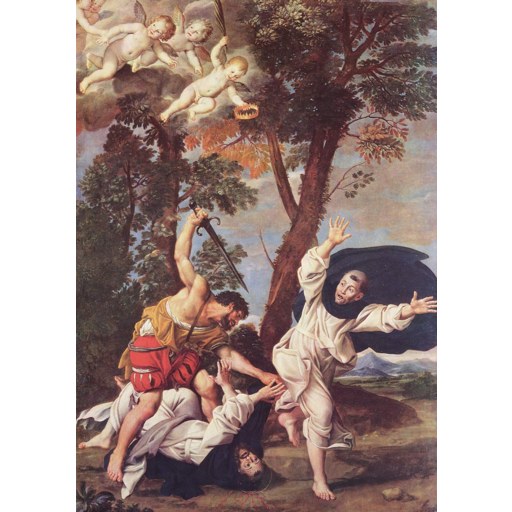
Domenichino
License: Public domain
Carino of Balsamo
Blessed- Life Span
- d. 1293
- Feast Day
- 28 April
- Gender
- male
- Church
- Catholic
Places
Roles & Family
Religious Information
Biography
Carino of Balsamo, also known as Carino Pietro of Balsamo, was a thirteenth-century Lombard remembered in Catholic hagiography both as the assassin of the Dominican preacher and inquisitor Saint Peter of Verona (Peter Martyr) and, after a public conversion, as a Dominican lay brother later styled blessed. He was born at Balsamo, a village near Milan that today forms part of Cinisello Balsamo in Lombardy; no reliable source records the year of his birth, and almost nothing is known of his family, occupation, or beliefs before the crime that made him notorious. In the religious conflicts of mid-thirteenth-century Lombardy, opponents of the papal inquisition—commonly identified in the sources as Cathars or Patarines—hired him to kill Peter, who had been preaching against heresy in the region of Como and Milan and serving as inquisitor.
On 6 April 1252, as Peter and his Dominican companion, Brother Dominic, were travelling from Como toward Milan, Carino ambushed them on the road near Barlassina, in the territory of Seveso. He struck Peter on the head with a billhook or similar cutting weapon, inflicting a mortal wound. Traditional accounts, already circulating in the years immediately after the murder, hold that the dying Peter traced on the ground in his own blood the opening of the Creed, Credo in unum Deum. Carino also wounded Dominic, who died of his injuries a few days later. Peter’s death was treated as martyrdom almost at once; he was canonized by Pope Innocent IV in 1253, one of the most rapid canonizations of the medieval papacy. An accomplice associated with the attack in some narratives fled and is not followed in the later Carino tradition.
Carino himself fled after the killing and was later seized at Forlì in Romagna and imprisoned. While in prison he fell seriously ill. A Dominican priest then at Forlì, Blessed Giacomo Salomoni (James Salomoni) of Venice, attended him. Under that pastoral care Carino confessed the murder, professed repentance, and was reconciled to the Church. After his recovery he sought admission to the Order of Preachers as a lay brother (conversus) and was received at the Dominican convent in Forlì. There he spent the rest of his life, some four decades, in the humble labours of a lay brother and in the penitential discipline that Dominican and local tradition thereafter presented as the fruit of his conversion. No contemporary document details a wife or children, and his later life was that of a religious in the Dominican house at Forlì.
He died at Forlì in 1293 and was buried at the Dominican convent where he had lived. A local cult grew around his memory as a converted assassin and model of penitence, and he came to be commemorated as Blessed Carino of Balsamo, with a feast observed on 28 April in some calendars. He was not the subject of a formal modern canonization, and the precise papal act, if any, that confirmed his cult is not firmly established in the sources that can be verified here. His story remained closely bound to the martyrdom of Peter of Verona in Dominican preaching and in Italian hagiography, where it was told as an example of repentance after grave crime rather than as an independent saint’s life with a large dossier of miracles or patronages.