Cassian of Imola is a saint of the Catholic Church. Cassian of Imola's feast day is celebrated on 13 August. Cassian of Imola is the patron saint of Imola;Diocese of Imola;schoolteachers;teachers;stenographers;shorthand writers.
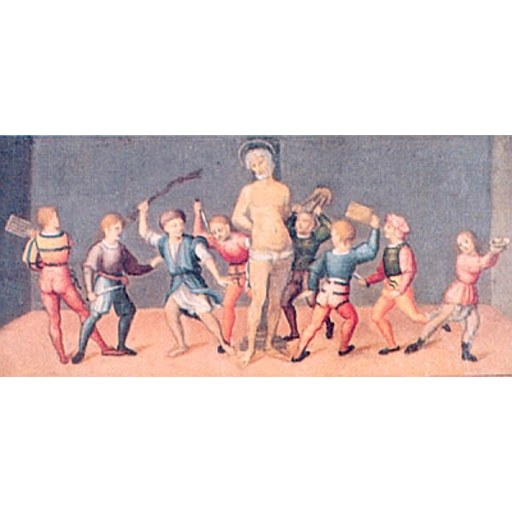
Innocenzo di Pietro Francucci da Imola
License: Public domain
Cassian of Imola
Saint- Feast Day
- 13 August
- Gender
- male
- Church
- Catholic
Places


Relics & Where to Venerate
Location unknown
The bodily remains of Cassian of Imola are a first-class relic. Venerated at Imola cathedral.
Roles & Family
Patronage
Imola;Diocese of Imola;schoolteachers;teachers;stenographers;shorthand writers
Biography
Cassian of Imola, known in Latin as Cassianus and associated with the Roman town of Forum Cornelii (modern Imola in Emilia-Romagna), was a Christian schoolmaster and martyr of the fourth century. The earliest and most important literary witness to his cult is the Spanish Christian poet Aurelius Prudentius Clemens, who, in the ninth hymn of his Peristephanon, composed around the year 400, describes a visit to Cassian’s tomb. Prudentius relates that he saw there a painted cycle depicting the saint’s passion and that a sacristan explained the story. According to this account, Cassian taught boys at Forum Cornelii, instructing them in letters and in the stenographic notes (notae) used for rapid writing. He was a Christian. When he was denounced in a time of persecution and refused to sacrifice to the gods, the judge, instead of handing him to professional executioners, delivered him to his own pupils. The boys, whom Prudentius portrays as having resented their master’s severity, attacked him with the iron styli they used to incise wax tablets, inflicting many small wounds until he died.
The precise date and imperial context of the martyrdom cannot be established from contemporary records. Medieval martyrologies and much later hagiography commonly assign Cassian’s death to the Great Persecution under Diocletian at the beginning of the fourth century, often to 13 August 303 or 304. Some modern historians have instead connected the story with the reign of Julian the Apostate (361–363), whose policies barred Christians from teaching the classical curriculum and who was remembered for hostility toward Christian educators. Neither hypothesis rests on a dated inscription or an eyewitness chronicle; both remain conjectural. Prudentius does not call Cassian a bishop or a priest. Later local tradition at Imola sometimes identified the martyr with an early bishop of the see, but that identification is not supported by the fourth- and fifth-century evidence and should be treated as legendary.
Cassian’s feast on 13 August appears in the Martyrologium Hieronymianum and was received into the Roman Martyrology, which commemorates him as a martyr of Imola killed by his students. His relics have been venerated at Imola from late antiquity. The cathedral of the city, the Cattedrale di San Cassiano Martire, is dedicated to him and remains the principal shrine. He is the patron saint of Imola and of the diocese. Because he was remembered as a teacher of writing and shorthand who died by the instruments of his trade, he has been invoked as patron of schoolteachers, of teachers more generally, and of stenographers and practitioners of shorthand. His iconography typically shows him as a schoolmaster, often seated, surrounded by boys who stab him with pens or styli.
Beyond Prudentius’s poem, the entry in the Hieronymian Martyrology, and the continuous local cult at Imola, almost nothing about Cassian’s biography can be verified. His place and year of birth are unknown. No reliable source records his family, whether he was married, or any ecclesiastical career other than the schoolmaster’s office described by Prudentius. The passion narrative itself is a literary and devotional text of the late fourth or early fifth century and may include conventional or legendary elements. What can be said with confidence is that by about 400 a martyr named Cassian was honored at Forum Cornelii with a tomb, paintings, and a story of death at the hands of his pupils, and that this cult made him one of the characteristic saints of the Christian school and of the city of Imola.