Castor of Karden is a saint of the Catholic Church. Castor of Karden's feast day is celebrated on 13 February. Castor of Karden is the patron saint of Koblenz.
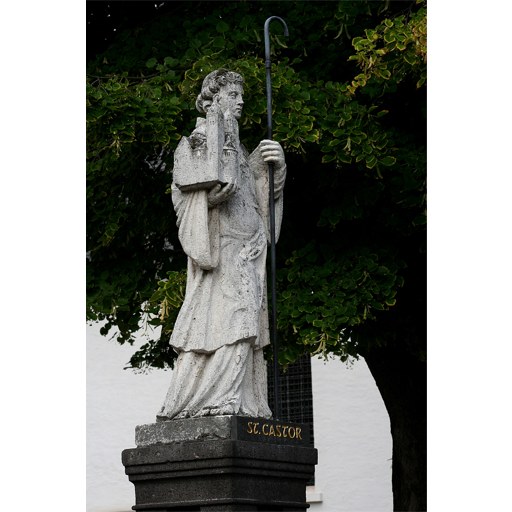
Lothar Spurzem
License: CC BY-SA 2.0 de
Castor of Karden
Saint- Feast Day
- 13 February
- Gender
- male
- Church
- Catholic
Places
Roles & Family
Patronage
Koblenz
Canonization
Biography
Saint Castor of Karden (Latin Castor Cardonensis; German Kastor von Karden) was a Christian priest and hermit of the fourth century, venerated as a saint in the Catholic Church, whose cult is centered on the Moselle valley in what is now western Germany. Later medieval tradition holds that he was born in Aquitaine in Roman Gaul and that he became a disciple of Maximinus, bishop of Trier (died in the mid-fourth century), who ordained him to the priesthood. No contemporary documentation of Castor’s life survives. The details of his origin, education, and ordination rest on hagiographical accounts written centuries after the period in which he is said to have lived, and historians therefore treat the fourth-century biography with caution while accepting the antiquity of his local cult.
After ordination, Castor is said to have withdrawn to the lower Moselle and taken up an eremitical life at Karden (Latin Cardena), a riverside settlement in the sphere of Trier. Tradition describes him as living there with a small group of companions, combining priestly ministry with ascetic withdrawal in a manner typical of early Gallic and Rhenish hermits. He is credited in legend with missionary work among the local population and with helping to establish Christian practice along the Moselle. Other holy names later attached to Karden, including Potentinus and the companions Felicius and Simplicius, belong to related local legend; the precise historical relationship among these figures cannot be verified from early sources.
Castor is believed to have died at Karden around the year 400 and to have been buried there. A cult developed at his tomb. In 836 Archbishop Hetto of Trier had the relics translated from Karden to Koblenz, where a church dedicated to Castor was consecrated in the same year. That church, the Basilica of St. Castor (St. Kastor or Kastorkirche) at the confluence of the Moselle and the Rhine, became a major religious and political site in the medieval Church of Trier and remains the principal focus of the saint’s veneration. Koblenz regards Castor as its patron saint. His feast is kept on 13 February.
Castor is not recorded as a bishop, pope, or patriarch, and he belonged to no later medieval religious order. His historical importance is local and regional: as a remembered priest-hermit of the Moselle, as titular of one of Koblenz’s foremost churches, and as patron of that city. The ninth-century translation of relics is the earliest well-attested event in his cult; the fourth-century life remains largely a matter of pious tradition rather than independently verified biography.