Catellus of Castellammare is a saint of the Catholic Church. Catellus of Castellammare's feast day is celebrated on 19 January. Catellus of Castellammare is the patron saint of Castellammare di Stabia.
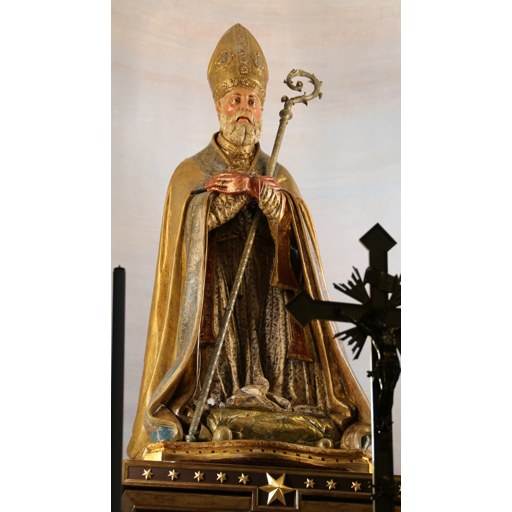
Sailko
License: CC BY 3.0
Catellus of Castellammare
Saint- Feast Day
- 19 January
- Gender
- male
- Church
- Catholic
Places
Roles & Family
Patronage
Castellammare di Stabia
Biography
Saint Catellus, known in Italian as San Catello, is a Christian bishop of the ninth century associated with the ancient see of Stabiae, today Castellammare di Stabia on the Gulf of Naples in Campania. Hagiographic tradition presents him as a native of that city who later occupied its episcopal chair. Contemporary documentary evidence for his life is lacking, and the details that survive belong to local legend, liturgical commemoration, and later medieval and early modern accounts rather than to charters or chronicles of his own day. He is remembered above all as a friend and sometime companion of Saint Antoninus of Sorrento, a Benedictine abbot whose own cult is likewise centered on the Sorrentine peninsula. Neither a precise year of birth nor a securely documented year of death can be established from reliable contemporary sources; a death date of 917 is often repeated in later tradition, but it is not independently confirmed and sits awkwardly with the usual chronology of Antoninus, who is placed in the first third of the ninth century.
According to the received story, Catellus and Antoninus withdrew from pastoral cares to live as hermits on Monte Aureo, the peak now called Monte Faito in the Lattari Mountains, which rises steeply above Castellammare. There they practiced a life of prayer and austerity. Legend holds that the Archangel Michael appeared to Catellus and commanded that a church in the archangel's honor be built on the height. The sanctuary of San Michele Arcangelo on Monte Faito, long a destination of pilgrimage from the surrounding towns, is the monument traditionally linked to that vision. Versions of the tale also speak of danger on the mountain, sometimes figured as a dragon or demonic presence, which the archangel helped the hermits to overcome.
The same tradition relates that the people of Castellammare, distressed by the absence of their bishop and by the insecurity of a coast exposed in the ninth century to Saracen raids, insisted that Catellus return to his see. He left the hermitage, while Antoninus eventually took up his work at Sorrento. Some later narratives add that Catellus was slandered, taken to Rome, and freed through the intercession or miraculous intervention of Antoninus, after which the two men resumed their association with the mountain sanctuary. These episodes cannot be verified independently; they reflect a familiar pattern in southern Italian hagiography, in which episcopal duty, eremitical withdrawal, angelic patronage, and deliverance from accusation or invasion are woven together. Catellus is not recorded as a member of a formal religious order, though his period of hermit life is central to his legend, and no spouse or children are mentioned in the tradition.
Catellus is honored as the principal patron of Castellammare di Stabia. His feast is kept on 19 January. Relics attributed to him are preserved in the cathedral of Castellammare, which is dedicated to the Assumption of the Blessed Virgin Mary and to San Catello. The historical bishop-list of Stabiae is fragmentary for the early Middle Ages, and his cult belongs to the pre-congregation era of local veneration rather than to a documented papal canonization. What can be said with confidence is that a local cult of Bishop Catellus took root in Campania, that it was joined to the mountain shrine of Saint Michael and to the civic identity of Castellammare, and that it has continued in liturgy, art, and public festivity. The former diocese of Castellammare di Stabia is now united with Sorrento in the Archdiocese of Sorrento-Castellammare di Stabia, which still maintains his memory.