Catherine de Francheville is a venerable of the Catholic Church (1620 - 1689).
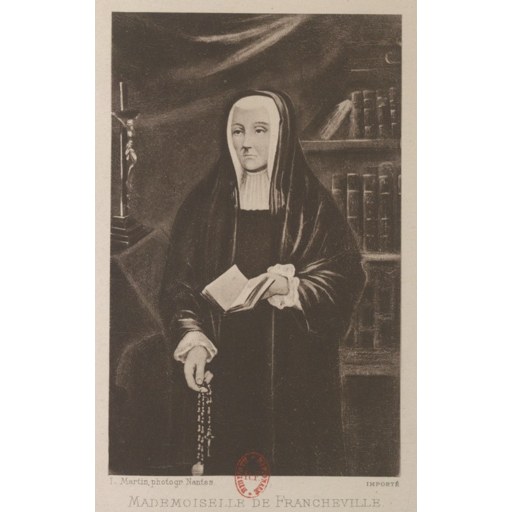
Martin
License: Public domain
Catherine de Francheville
Venerable- Life Span
- 1620 - 1689 (age 69)
- Gender
- female
- Church
- Catholic
Places
Roles & Family
Religious Information
Biography
Catherine de Francheville was born in 1620 in Ploërmel, in the historic province of Brittany in northwestern France. She belonged to a family of the local Breton nobility and received a Christian education typical of her social class in the seventeenth century. After the death of her father she settled in Vannes, the episcopal city of the region, which remained her home for the rest of her life. There she developed a serious interior life and came into contact with the Society of Jesus, whose members were then promoting the Spiritual Exercises of Saint Ignatius of Loyola among the laity of Brittany.
In Vannes she collaborated closely with the Jesuit Vincent Huby, a leading organizer of closed retreats. Women at that period had far fewer opportunities than men for structured spiritual formation of this kind. From the 1660s Catherine de Francheville therefore set herself to make Ignatian retreats available to women of various social conditions. She herself made the Exercises and then began to receive other women for periods of prayer, examination of conscience, and spiritual direction modeled on Jesuit practice.
Around the mid-1670s she established a dedicated house in Vannes to host these retreats. A community of women formed around the work; they lived a common life of prayer and service and staffed the retreat house. That community is regarded as the origin of the religious congregation later known as the Sisters of La Retraite (Religieuses de La Retraite). The sisters combined contemplative prayer with the active ministry of giving the Spiritual Exercises. Catherine de Francheville directed this apostolate until her death. She never married and had no children, having consecrated her life to the retreat work.
She died in Vannes in 1689. After her death the congregation she had inspired continued in Brittany and, in later centuries, established houses beyond France. She is remembered in Catholic history as a pioneer of the retreat movement for women in seventeenth-century France. She has not been beatified or canonized, and no feast day is assigned to her in the general liturgical calendar.