Catherine of Parc-aux-Dames is a blessed of the Catholic Church.
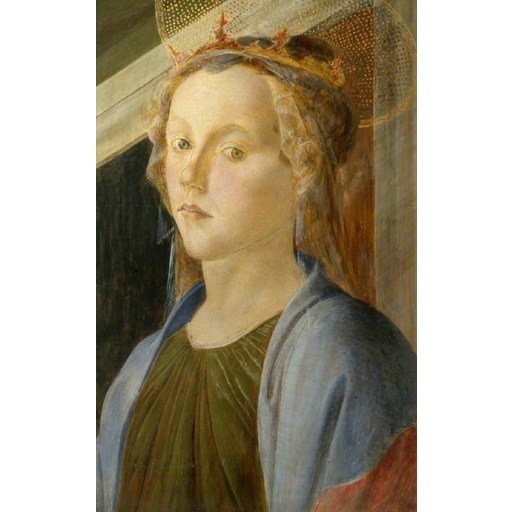
https://artuk.org/discover/stories/wheels-books-and-swords-how-to-spot-saint-catherine-in-art
License: unknown
Catherine of Parc-aux-Dames
Blessed- Gender
- female
- Church
- Catholic
Places
Roles & Family
Religious Information
Biography
Catherine of Parc-aux-Dames, also called Catherine of Louvain, was a thirteenth-century Jewish convert to Christianity who became a Cistercian nun at the abbey of Parc-aux-Dames (in Dutch, Vrouwenpark) in the Duchy of Brabant, near Leuven in the southern Low Countries. Nearly all that can be said of her rests on a single medieval witness, the Dominican Thomas of Cantimpré (c. 1201–1272), who included her story in his moral encyclopedia Bonum universale de apibus, compiled in the 1250s and early 1260s. Thomas presents her as a living example of grace among converts and claims personal knowledge of the nun and of her convent. No independent archival dossier, convent necrology, or contemporary Jewish source has been identified, so the outline of her life remains that of a hagiographical exemplum rather than a fully documented biography. Precise years of birth and death are not recorded in any source that can be verified.
According to Thomas, Catherine was a Jewish child associated with the city of Cologne in the Holy Roman Empire. As a very young girl she was drawn to Christian worship and especially to devotion to the Virgin Mary, and she expressed a wish to be baptized and to live as Christians did. Her family, alarmed by these inclinations, is described as having tried to keep her within the Jewish community. Around the age of twelve she left her home, received baptism, and took the Christian name Catherine. She was then received into the Cistercian nunnery of Parc-aux-Dames, a house of white nuns founded in the early thirteenth century in the countryside near Leuven, within the orbit of the dukes of Brabant and of the Cistercian filiation of the region. The convent, not the city of her childhood, is the origin of the names by which she is known.
Her conversion provoked a conflict with her father, who attempted to recover her from the cloister and to challenge the validity of a baptism conferred on a minor without parental consent. The episode belongs to a wider thirteenth-century debate, in canon law and in princely courts, over the baptism of Jewish children and the rights of Jewish parents after the Fourth Lateran Council. Thomas depicts Catherine as steadfast under examination, affirming the Christian faith of her own will. Secular and ecclesiastical authorities in Brabant became involved; the precise legal outcome is known only through his narrative, which presents her remaining in the monastery as a triumph of divine election. Modern historians treat the story as evidence both of real conversionary pressure in the urban Rhineland and Brabant and of the way mendicant authors constructed exemplary Jewish converts for Christian audiences. Her original Jewish name is not securely attested in the primary account, and her parents are not named.
Thomas indicates that he later visited Parc-aux-Dames and found Catherine living as a professed Cistercian nun, reputed for piety. He wrote while she was still alive, which places her floruit in the middle decades of the thirteenth century but does not yield a death date, a place of death, or a burial site, though she almost certainly remained at the abbey. Nothing reliable is recorded of any later offices she may have held, of writings, or of miracles at a tomb. She has sometimes been styled blessed in later Catholic and Cistercian commemorations, yet there is no clear evidence of a formal papal beatification or canonization, nor of a universally established feast in the Roman Martyrology. Local or order-specific remembrance, if it existed, has left little trace in surviving calendars, and no patronages are documented.
Parc-aux-Dames was one of several Cistercian nunneries that flourished in thirteenth-century Brabant, a region already notable for religious women, including beguines, and for Dominican and Cistercian hagiography. Catherine’s story was transmitted because it served Thomas’s themes of conversion, Marian devotion, and the boundary between Jewish and Christian communities in the cities of the Holy Roman Empire and the Low Countries. Beyond that narrative the historical woman remains obscure. She is nonetheless a figure of interest for the history of Jewish–Christian relations, the canon-law problem of child conversion, and women’s monasticism in thirteenth-century northwestern Europe, provided her life is not padded with dates and details that the sources do not actually supply.