Catherine of Racconigi is a blessed of the Catholic Church (1486 - 1547). Catherine of Racconigi's feast day is celebrated on 4 September.
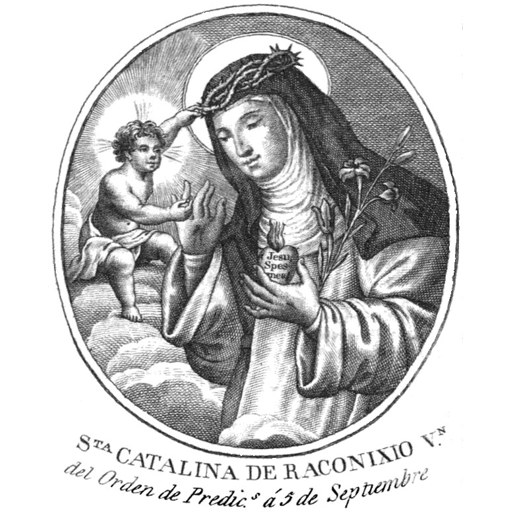
Unknown authorUnknown author
License: Public domain
Catherine of Racconigi
Blessed- Life Span
- 1486 - 1547 (age 61)
- Feast Day
- 4 September
- Gender
- female
- Church
- Catholic
Places
Roles & Family
Religious Information
Canonization
Biography
Catherine of Racconigi, born Caterina Mattei in 1486 in the Piedmontese town of Racconigi, then part of the Duchy of Savoy, came from a poor artisan household. Traditional Dominican biographies name her father as Giorgio Mattei, a locksmith whose trade did not always keep the family from want. She grew up in the late fifteenth century, when Dominican spirituality and the lay tertiary vocation were already well established in northern Italy. Hagiographical sources, written chiefly within the Order of Preachers, describe her as given to prayer from childhood and as reporting visions of Christ, the Virgin Mary, and saints while still very young. Because her family lacked the means to provide a convent dowry, she could not enter a monastery as a choir nun, a common barrier for poor girls of that era.
She was instead received into the Third Order of Saint Dominic and lived as a tertiary at Racconigi rather than in enclosure. She wore the Dominican tertiary habit and followed a life of fasting, night prayer, and charity, remaining under the direction of confessors of the Order. Sixteenth-century and later Dominican accounts present her as an ecstatic and a stigmatist. The stigmata were said to have been granted in union with the Passion but to have remained hidden from ordinary view for much of her life. She was also credited with prophecy, discernment of souls, and extraordinary phenomena such as levitation or bilocation. Those claims belong to the mystical literature of the period and are not independently documented in the manner of modern historical criticism. Townspeople and, according to the same tradition, members of the Savoyard nobility sought her prayers and counsel.
Her path was marked by opposition as well as veneration. Poverty, misunderstanding within her own family, and suspicion of her trances exposed her to insult and to accusations that she was deluded or engaged in forbidden arts. Such trials are a recurring theme in the vitae of Italian women mystics of the fifteenth and sixteenth centuries. She persisted in her tertiary vocation through the wars and political disturbances that affected Piedmont in the first half of the sixteenth century. Biographers depict her as offering her sufferings in union with Christ and as remaining loyal to the Dominican Order and to the Catholic Church at a time that also saw the early Reformation north of the Alps.
Catherine died on 4 September 1547, at about sixty-one years of age. Devotion to her took root locally in Racconigi and among Dominicans. In 1808 Pope Pius VII confirmed her cult, which constitutes her beatification. She has not been the subject of a subsequent general canonization and is therefore styled Blessed rather than Saint in official Catholic usage. Her feast is kept on 4 September. Beyond the Dominican hagiographical tradition, strictly contemporary documentation is relatively thin, and many miracle stories attached to her name rest on later pious compilation rather than on a dense archival record.