Catherine of Siena is a saint of the Catholic Church (1347 - 1380). Catherine of Siena's feast day is celebrated on 29 April. Catherine of Siena is the patron saint of Italy;Europe;Siena;nurses;the sick;against fire;fire prevention;against bodily ills;people ridiculed for their piety;those who have suffered miscarriages;against sexual temptation;Diocese of Allentown, Pennsylvania.
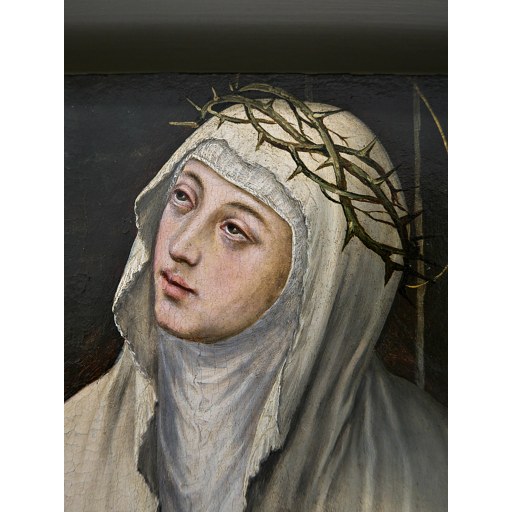
Jl FilpoC
License: CC BY-SA 4.0
Catherine of Siena
Saint- Life Span
- 1347 - 1380 (age 33)
- Feast Day
- 29 April
- Gender
- female
- Church
- Catholic
Places


Relics & Where to Venerate
Location unknown
The bodily remains of Catherine of Siena are a first-class relic. Venerated at Santa Maria sopra Minerva.
Location unknown
Basilica of San Domenico in Siena, where her incorrupt head is preserved
Location unknown
The head of St. Catherine of Siena is venerated at the Basilica of San Domenico in Siena.
Roles & Family
Religious Information
Patronage
Italy;Europe;Siena;nurses;the sick;against fire;fire prevention;against bodily ills;people ridiculed for their piety;those who have suffered miscarriages;against sexual temptation;Diocese of Allentown, Pennsylvania
Canonization
Biography
Catherine of Siena, born Caterina di Jacopo di Benincasa in 1347 in Siena in Tuscany, was the daughter of the wool dyer Jacopo di Benincasa and Lapa Piagenti. She belonged to a large family; later Dominican tradition, following her confessor Raymond of Capua, numbered some twenty-five children, of whom a twin sister died in infancy. Siena in the mid-fourteenth century was a prosperous but politically turbulent republic, recently scarred by the Black Death of 1348. According to the earliest lives, Catherine experienced a vision of Christ with the apostles when she was about six years old and thereafter formed the intention of belonging wholly to God. In adolescence she refused the marriage her parents arranged, cut her hair, and after a period of domestic conflict was allowed to join the Mantellate, laywomen of the Dominican Third Order who wore a habit but lived in their family homes rather than in a cloister.
As a tertiary she adopted an austere regimen of prayer, works of charity among the poor and the sick of Siena, and extreme fasting that her own letters and later historical discussion have made famous. She claimed a mystical marriage to Christ and, according to Raymond of Capua, received the stigmata in a form invisible to others during her lifetime. Although she never received a formal scholastic education and remained a laywoman, she dictated hundreds of letters in the Tuscan vernacular to popes, cardinals, princes, condottieri, and private persons, urging conversion, peace among the Italian city-states, and reform of the clergy. In the later 1370s she dictated her principal theological work, the Dialogue, also called the Book of Divine Providence, a long conversation between God and the soul on charity, prayer, obedience, and the wounds of the Church.
Catherine's public role unfolded against the Avignon Papacy and the opening of the Western Schism. She pressed Pope Gregory XI to restore the papal residence to Rome and traveled to Avignon in 1376; Gregory returned to Rome in January 1377, an event in which her advocacy was one among several political and religious factors. After Gregory's death in 1378 and the contested election of Urban VI, she took Urban's side against the Avignon claimant Clement VII, writing urgently in defense of Roman obedience and spending her final years in Rome at Urban's invitation. There she continued to counsel the pope, to work for peace in Italy, and to gather a circle of disciples. Her health, already undermined by years of fasting and illness, collapsed; she died in Rome on 29 April 1380, aged about thirty-three.
Devotion to Catherine spread rapidly through Dominican channels. Raymond of Capua's Legenda maior became the foundational hagiography. Pope Pius II, a native of the Sienese territory, canonized her on 29 June 1461. Her body was laid in the Dominican church of Santa Maria sopra Minerva in Rome, where it remains; her head was translated to the Basilica of San Domenico in Siena, where it is still venerated. In 1939 Pope Pius XII named her, together with Francis of Assisi, a principal patron of Italy. Pope Paul VI declared her a Doctor of the Church in 1970, and Pope John Paul II named her a patron of Europe in 1999. The Roman liturgy keeps her feast on 29 April. Her letters and the Dialogue remain central texts of late medieval Italian religious literature and of Dominican spirituality.