Cedd is a saint of the Catholic Church (d. 664). Cedd's feast day is celebrated on 26 October. Cedd is the patron saint of Essex.
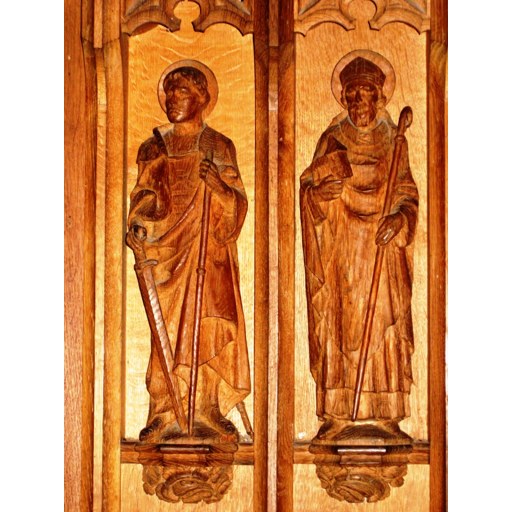
Weglinde
License: CC BY-SA 3.0
Cedd
Saint- Life Span
- d. 664
- Feast Day
- 26 October
- Gender
- male
- Church
- Catholic
Places
Roles & Family
Patronage
Essex
Canonization
Biography
Cedd was a seventh-century Northumbrian monk and bishop, known principally through the narrative of the Venerable Bede in the Ecclesiastical History of the English People. He was one of four brothers—Cedd, Cynibil, Caelin, and Chad (Ceadda)—who all entered the priesthood and were associated with the monastic life of Lindisfarne. Cedd received his formation there under Aidan, in the Irish Christian customs then prevailing in Northumbria. No contemporary source records his year or place of birth beyond his Northumbrian origin, and later round figures sometimes offered for his birth are conjectural.
In the mid-seventh century Cedd was sent, with other priests, to preach among the Middle Angles after the conversion of their ruler Peada, son of Penda of Mercia. He was later consecrated bishop by Finan of Lindisfarne for the East Saxons, whose king Sigeberht had accepted baptism under Northumbrian influence. As bishop among the East Saxons he established Christian communities and monastic centres, including foundations at Ythancaestir (identified with Bradwell-on-Sea in Essex, where a surviving chapel of St Peter is associated with his mission) and at Tilaburg (Tilbury). He continued to move between this southern charge and Northumbria rather than residing permanently in Essex.
At the invitation of Æthelwald, king of Deira, Cedd founded a monastery at Lastingham (Læstingaeu) in the North York Moors. Bede relates that Cedd sought to purify the site by a Lenten fast of forty days, a discipline completed by his brother Cynibil when Cedd was called away on pastoral business. Cedd served as abbot of Lastingham while remaining bishop of the East Saxons. In 664 he took part in the Synod of Whitby, where the Northumbrian church debated Roman and Irish practices, above all the dating of Easter. Bede states that Cedd acted as a skilled interpreter between the parties and that he accepted the synod’s decision in favour of the Roman computation.
Cedd died of plague at Lastingham in 664, a year of widespread mortality in England in the aftermath of the synod. His feast is kept on 26 October. A number of monks from his Essex monasteries came north to Lastingham around the time of his death, and some of them also died in the same outbreak. He was first buried in the open air at the monastery; when a stone church dedicated to the Mother of God was later built, his remains were translated and placed at the right of the altar. His brother Chad succeeded him as abbot of Lastingham. Cedd has been venerated as a saint from an early date in the English church, without a later papal process of canonization, and is remembered especially as the apostle of the East Saxons.