Celestine I is a saint of the Catholic Church (d. 432). Celestine I's feast day is celebrated on 6 April.
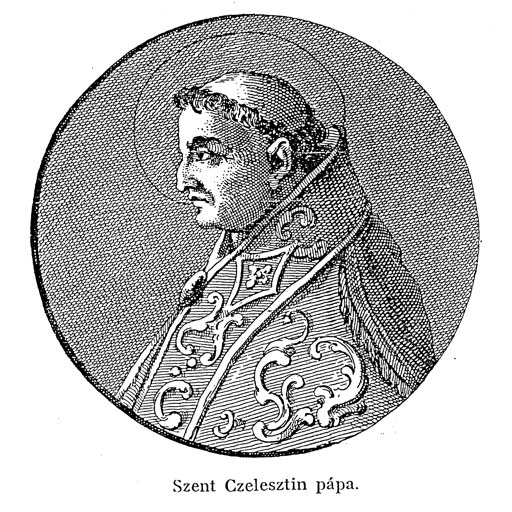
Crescens Lajos Dedek
License: CC BY-SA 3.0
Celestine I
Saint- Life Span
- d. 432
- Feast Day
- 6 April
- Gender
- male
- Church
- Catholic
Places
Roles & Family
Canonization
Biography
Pope Celestine I, known in Latin as Caelestinus, was Bishop of Rome from 422 until his death in 432. According to the Liber Pontificalis he was Campanian by origin, the son of a man named Priscus; no reliable source records the year or a precise town of birth, and almost nothing can be established about his childhood or education. He first appears in the historical record as a Roman deacon in the time of Pope Innocent I, his name occurring among the Roman clergy in the mid-410s. After the death of Pope Boniface I he was elected to the Roman see in September 422, at a moment when the Western Empire was politically fragile and the churches of Africa, Gaul, Britain, and the East were occupied with unfinished doctrinal disputes.
His pontificate is known chiefly from his letters and from contemporary chroniclers such as Prosper of Aquitaine. Celestine was a determined opponent of Pelagianism. He upheld the anti-Pelagian decisions of his predecessors and of the African bishops, and he remained in close relations with Augustine of Hippo, who died in 430 during Celestine’s reign. In 429, according to Prosper, Celestine authorized the mission of Bishop Germanus of Auxerre to Britain in order to combat Pelagian teaching there. In 431 he ordained Palladius and sent him as bishop to the Irish Christians, an act recorded in Prosper’s Chronicle and generally regarded as the first historically attested episcopal mission to Ireland. Celestine also intervened in Gaul against teachers later described as Semi-Pelagian, writing to the bishops of southern Gaul in support of Augustine’s doctrine of grace and rebuking those who resisted it. He continued to treat the bishop of Thessalonica as papal vicar in Illyricum and corresponded with Eastern sees on questions of faith and discipline.
The most consequential episode of his reign was the Nestorian controversy. After Nestorius became bishop of Constantinople in 428, preaching associated with him appeared to deny that Mary could rightly be called Theotokos (God-bearer). Cyril of Alexandria appealed to Rome. In 430 Celestine held a synod in Rome which condemned that teaching and instructed Cyril to act as Celestine’s representative in requiring Nestorius to recant. Celestine then sent three legates—the bishops Arcadius and Projectus and the priest Philip—to the Council of Ephesus, which opened in 431. Although the legates arrived after the council’s first sessions, they confirmed in Celestine’s name the deposition of Nestorius and the council’s affirmation of the title Theotokos. Celestine received the decrees and thereafter treated the decision as binding on the churches in communion with Rome.
Notices of building and liturgy under Celestine are thinner and sometimes legendary. An inscription in the basilica of Santa Sabina on the Aventine, erected in this period by the priest Peter of Illyria, names Celestine as the pope then occupying the see of Peter. The Liber Pontificalis credits him with work on a basilica of Saint Mary, often identified with Santa Maria in Trastevere, and with gifts of liturgical plate, though such attributions in that source must be used with caution. Celestine died in Rome in 432 and was succeeded by Sixtus III. He was buried in the Cemetery of Priscilla on the Via Salaria; in later centuries his relics were translated to the basilica of Santa Prassede. He has been venerated as a saint from an early date, without a formal canonization of the later medieval type. In the Latin church his traditional feast day is 6 April; some Eastern calendars commemorate him on 8 April.