Cesidius, Placidus, and Eutichius is a saint of the Catholic Church.
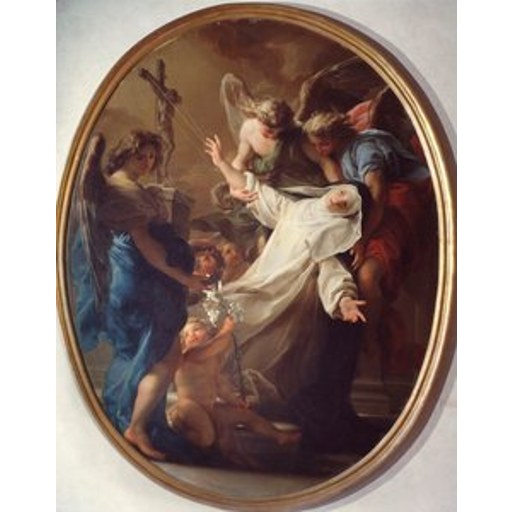
https://www.meisterdrucke.us/fine-art-prints/(c.1489-1534)-Correggio/1511920/Martyrdom-of-St.-Placidus,-Flavia,-Eutychius-and-Victorinus.html
License: unknown
Cesidius, Placidus, and Eutichius
Saint- Gender
- male
- Church
- Catholic
Roles & Family
Biography
Cesidius, Placidus, and Eutichius appear in some modern listings as a grouped trio of Christian saints, but a connected, source-based biography of the three as companions cannot be verified from the principal printed martyrologies or from standard critical hagiography. The three names are each known separately in the Latin Christian tradition. Cesidius (Italian Cesidio) is associated in Abruzzese tradition with a deacon-martyr of Trasacco, often linked to Saint Rufinus and placed by later legend in the age of the Roman persecutions; that local figure is not, in the better-known accounts, accompanied by Placidus and Eutichius. Placidus is the name of the disciple of Benedict of Nursia whose medieval Sicilian passion, widely regarded as legendary, names brothers Eutychius and Victorinus and a sister Flavia among his companions at Messina, but does not name Cesidius. Eutichius (Eutychius, Eutichio) is a relatively common late-antique saint’s name, borne by several martyrs and by at least one well-documented sixth-century patriarch of Constantinople who has no connection with a Cesidius or a Placidus. Whether the present grouping records a distinct local cult, a liturgical conflation of homonyms, or a set of names drawn from a little-known passion narrative remains uncertain.
No contemporary acta, inscriptions, or reliable early calendars have been identified that would fix a year of birth or death, a city of origin, or a place of burial for the three as a group. Assignments to a particular persecution (for example that of Diocletian) or to a particular Italian region circulate in secondary and local writing but lack independent corroboration and should not be treated as established fact. The Hieronymian Martyrology, the medieval martyrologies of Bede, Ado, and Usuard, and the typical editions of the Roman Martyrology do not, under a single coordinated entry, present Cesidius, Placidus, and Eutichius alone as a closed trio of companions. In the absence of such an entry, later church dedications, relic lists, or art-historical captions remain the only possible witnesses to a joint cult, and those witnesses have not been securely published in a form that would allow dates, places, or circumstances to be stated with confidence.
Nothing verifiable is known of any religious order, marriage, or children. The three names are masculine, and none of the figures so named in this grouping held the see of Rome or a patriarchal or catholicosal see of the Eastern churches. Formal papal canonization or beatification of the kind later regulated by the Congregation of Rites is not recorded; if a historical cult existed, it would belong to the large class of early saints recognized by popular acclaim and episcopal or monastic tradition rather than by a modern process. Patronages attached to the trio as such are not listed in the standard reference works.
The persistence of the three names together in at least one modern catalogue indicates that a joint commemoration has been asserted somewhere in the Italian or wider Catholic world, but the medieval liturgical or narrative evidence behind that assertion has not been identified with certainty. Further work in local archives, diocesan calendars, and church inventories would be required before Cesidius, Placidus, and Eutichius could be described as historical companions rather than as a conventional grouping of independently attested, or even partly legendary, homonyms. Until such evidence is produced, the historian can say only that they are remembered as male saints of the early Christian centuries, that the details of their lives and deaths are unknown, and that they should not be confused without proof with the better-documented bearers of the same names.