Chad of Mercia is a saint of the Catholic Church (d. 672). Chad of Mercia's feast day is celebrated on 2 March. Chad of Mercia is the patron saint of Lichfield;Archdiocese of Birmingham.
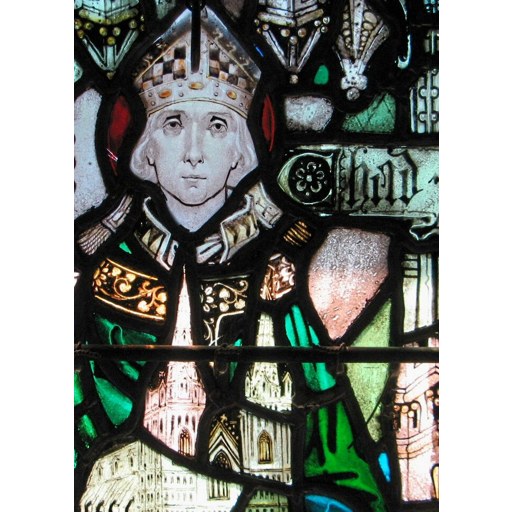
Randy OHC
License: CC BY 2.0
Chad of Mercia
Saint- Life Span
- d. 672
- Feast Day
- 2 March
- Gender
- male
- Church
- Catholic
Places

Relics & Where to Venerate
Location unknown
The bodily remains of Chad of Mercia are a first-class relic. Venerated at Lichfield Cathedral.
Location unknown
== Notable dedications == === Churches === Chad gives his name to Birmingham's Roman Catholic cathedral, where there are some relics of the saint: about eight long bones
Location unknown
The cult had twin foci: his tomb in the nave and more particularly his skull, kept in a special Head Chapel, alongside the south choir aisle
Housed at Lichfield Cathedral · United Kingdom
In November 2022, one bone relic was returned to Lichfield Cathedral and is housed in a new shrine in the retrochoir and close to where they were located in medieval times
Housed at St Chad's Cathedral · Birmingham, United Kingdom
The relics, six bones, were enshrined on the altar of St Chad's Cathedral
Location unknown
The Anglican Lichfield Cathedral, at the site of his burial, is dedicated to Chad, and St Mary, and still has a head chapel, where the skull of the saint was kept until it was lost during the Reformation
Location unknown
== Cult and relics == Chad is considered a saint in the Roman Catholic, the Anglican churches, the Celtic Orthodox Church and is also noted as a saint in a new edition of the Eastern Orthodox Synaxarion (Book of Saints)
Roles & Family
Patronage
Lichfield;Archdiocese of Birmingham
Canonization
Biography
Chad of Mercia, whose Old English name was Ceadda, was a seventh-century Anglo-Saxon monk and bishop known almost entirely from the account of the Venerable Bede in the Ecclesiastical History of the English People. He belonged to a Northumbrian family that produced four brothers in holy orders: Cedd, Cynebill, Caelin, and Chad himself. Formed in the Irish monastic tradition, he was a pupil of Aidan at Lindisfarne and later lived as a monk in Ireland, following a pattern common among Northumbrian churchmen of his generation. After Cedd died of plague in 664 at the monastery he had founded at Lastingham in Deira, Chad succeeded his brother as abbot there.
In the same year, after the Synod of Whitby, King Oswiu of Northumbria needed a bishop for the Northumbrian church. Wilfrid, who had been chosen for York, had gone to Gaul for consecration and did not return promptly. Oswiu therefore had Chad consecrated, the rite being performed by Wine, bishop of the West Saxons, and two British bishops. That consecration was later judged irregular because the British bishops were not in full conformity with Roman practice on Easter and related customs. Chad nonetheless administered the Northumbrian church from York with marked humility, travelling on foot to preach. When Wilfrid returned and Theodore of Tarsus arrived as archbishop of Canterbury in 669, Theodore found the consecration defective. Chad offered to resign without dispute, saying he had never thought himself worthy of the office. Theodore, impressed by this humility, regularized Chad’s orders but sent him back to Lastingham as abbot and restored York to Wilfrid.
King Wulfhere of Mercia then asked Theodore for a bishop. Theodore recalled Chad and appointed him bishop of the Mercians and of Lindsey, with his seat at Lichfield. There Chad organized the church in a large kingdom still only partly evangelized. He built a dwelling near the church at Lichfield and lived with a small community of seven or eight brothers, keeping a monastic round of prayer and study. Bede stresses his humility, his devotion to scripture, his care for the poor, and his refusal to ride; Theodore is said to have lifted him onto a horse so that he would spare himself on long journeys. His episcopate in Mercia lasted about two and a half years.
Chad died at Lichfield on 2 March 672 during an outbreak of plague. Bede records the testimony of the monk Owin, who heard heavenly singing and was told by Chad that angelic visitors had come to summon him and would return in seven days. Chad urged his brethren to keep their rule and to prepare for death; he died after receiving the last sacraments. He was first buried in the church of Saint Mary which he had built at Lichfield; his relics were later translated into the church of Saint Peter on the same site, the predecessor of Lichfield Cathedral. A cult arose quickly. Bede already treated him as a saint and reported healings associated with his tomb, including the use of dust from the wooden shrine. His feast is kept on 2 March. He remains closely identified with Lichfield and with the later Catholic Archdiocese of Birmingham, whose cathedral is dedicated to him.