Charbel Makhluf is a saint of the Catholic Church (1828 - 1898). Charbel Makhluf's feast day is celebrated on 24 July. Charbel Makhluf is the patron saint of Lebanon.
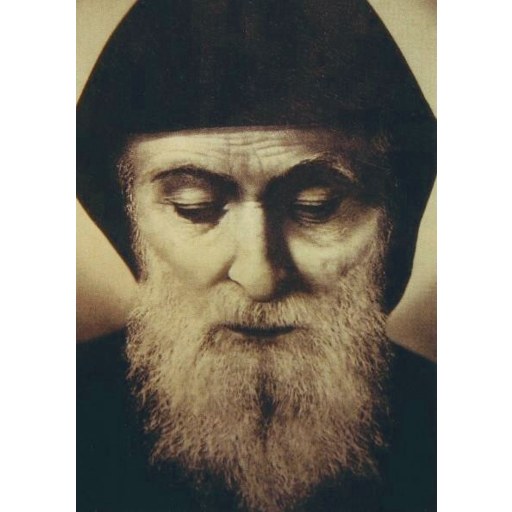
Unknown (Old Photo)
License: Public domain
Charbel Makhluf
Saint- Life Span
- 1828 - 1898 (age 70)
- Feast Day
- 24 July
- Gender
- male
- Church
- Catholic
Places
Relics & Where to Venerate
Housed at Cathedral of St. Maron · Lebanon
== Death and relics == Makhlouf was interred at the Monastery of Saint Maron on Christmas Day that year
Roles & Family
Religious Information
Patronage
Lebanon
Canonization
Biography
Charbel Makhlouf was born Youssef Antoun Makhlouf on 8 May 1828 in Bekaa Kafra, a high mountain village in northern Lebanon, then under Ottoman rule. His father, Antoun Zaarour Makhlouf, died while Youssef was still a young child, and he was raised by his mother, Brigitta Chidiac, in a poor Maronite household. From boyhood he was drawn to prayer and solitude, often withdrawing to a grotto while tending livestock. Two of his uncles lived as hermits, and their example, together with the long monastic tradition of Mount Lebanon, formed his vocation. In 1851, at about the age of twenty-three, he left home and entered the Monastery of Our Lady of Mayfouq of the Lebanese Maronite Order, taking the religious name Charbel after a second-century martyr of Edessa.
After his novitiate he transferred to the Monastery of Saint Maron at Annaya and made his religious profession in 1853. He studied philosophy and theology at the Monastery of Saints Cyprian and Justina in Kfifan, where one of his teachers was Nimatullah Kassab Al-Hardini, later canonized. Charbel was ordained a priest on 23 July 1859. For the following sixteen years he lived the common monastic life at Annaya, noted for strict observance, prolonged prayer, and manual labor. In 1875 he obtained permission to withdraw to the nearby Hermitage of Saints Peter and Paul, where he spent the last twenty-three years of his life as a hermit.
His eremitical rule was severe: long fasts, a hair shirt, a straw mattress, agricultural work, and almost unbroken silence, centered on the Divine Office and the Eucharist. He rarely left the hermitage. On 16 December 1898, while celebrating Mass, he suffered a stroke. He died on the evening of 24 December 1898 at the hermitage near Annaya and was buried at the Monastery of Saint Maron.
After his death, lights were reported at his tomb. When the grave was opened, the body was found incorrupt and exuding a blood-like moisture, phenomena that persisted for many years and drew pilgrims. Numerous healings were attributed to his intercession. He was beatified by Pope Paul VI on 5 December 1965, during the closing period of the Second Vatican Council, and canonized by the same pope on 9 October 1977. His tomb at Annaya remains a major pilgrimage site of the Maronite Church and of Lebanon.