Chrodegang is a saint of the Catholic Church (d. 766). Chrodegang's feast day is celebrated on 6 March.
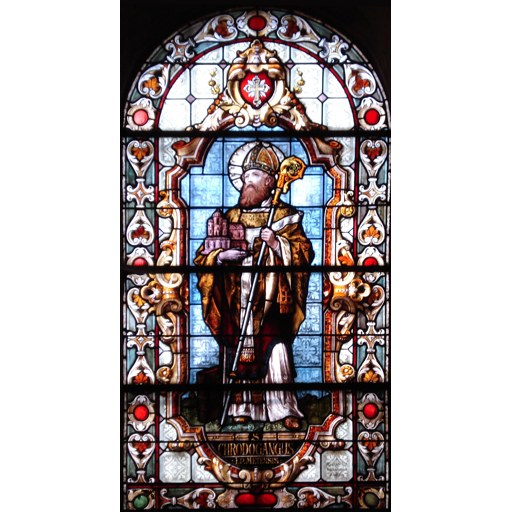
Graoully/Archimatth
License: CC BY 3.0
Chrodegang
Saint- Life Span
- d. 766
- Feast Day
- 6 March
- Gender
- male
- Church
- Catholic
Places
Roles & Family
Biography
Chrodegang, also called Chrodegang of Metz (Latin Chrodegangus), was a Frankish nobleman, royal counsellor, and bishop whose work shaped the Carolingian church in the eighth century. He was born in the early eighth century, often dated around 712, in the region of Hesbaye (Hasbania) in Austrasia, in the Frankish kingdom. Later tradition names his parents as Sigramnus and Landrada and places him among the Austrasian aristocracy related to the circle of the early Carolingians. He was educated at the court of Charles Martel, where he gained a strong command of Latin and of palace administration, and he served Charles as referendary, a senior chancery office. After Charles’s death he remained a trusted adviser of Pepin the Short.
Pepin made him bishop of Metz, traditionally in 742, though some reconstructions place the appointment a few years later; he held the see until his death. Metz was among the chief churches of Austrasia, and Chrodegang combined diocesan government with service as a royal envoy. When Pope Stephen II crossed the Alps in 753 to seek Frankish help against the Lombards, Chrodegang was sent to meet and escort the pope. The visit confirmed the alliance between the papacy and the Carolingian mayors, soon kings, of the Franks. In 754 Stephen conferred the pallium on Chrodegang, giving him the rank of archbishop although Metz was not then a metropolitan see in the later medieval sense. He thus stood at the meeting point of Frankish royal power and Roman ecclesiastical authority in the years when Carolingian kingship and the papal-Frankish pact were being formed.
As bishop he pursued a broad program of liturgical, canonical, and monastic reform. He promoted the Roman liturgy and Roman chant in place of older Gallican usages, obtaining books and trained singers from Rome and making Metz a leading Frankish centre for the Roman rite and for the chant later called Gregorian; a schola cantorum at Metz became famous for this work. About the middle of the century he composed a rule for his cathedral clergy, the Regula canonicorum or Rule of Chrodegang, requiring common life, enclosure, discipline, and a structured round of offices, and drawing on the Rule of Saint Benedict and on Roman clerical practice. The rule became a model for cathedral chapters and for later canons regular in the Frankish world. He also founded or fostered Benedictine houses, above all Gorze Abbey near Metz in the late 740s, which grew into a major reform centre. He took part in the establishment of Lorsch Abbey, receiving the foundation from Count Cancor and his mother Williswinda, consecrating its church, and placing it under his brother Gundeland as abbot.
Chrodegang further enriched the churches of his region by obtaining relics from Rome, including those of Saint Gorgonius for Gorze, and by restoring and building churches in and around Metz. He died at Metz on 6 March 766 and was buried at Gorze Abbey. His feast is kept on 6 March. Later generations remembered him as a principal architect of the Carolingian church’s Romanizing reforms, as the organizer of canonical life in the Frankish cathedral, and as a bishop whose foundations and liturgical work at Metz and Gorze influenced Western monasticism and worship for centuries. He was venerated as a saint from an early date; no record survives of a formal papal canonization of the later medieval type.