Clare of Assisi is a saint of the Catholic Church (1194 - 1253). Clare of Assisi's feast day is celebrated on August 11. Clare of Assisi is the patron saint of television;eye disease;goldsmiths;laundry workers;embroiderers;gilders;needleworkers;good weather;Assisi;Santa Clara, California.
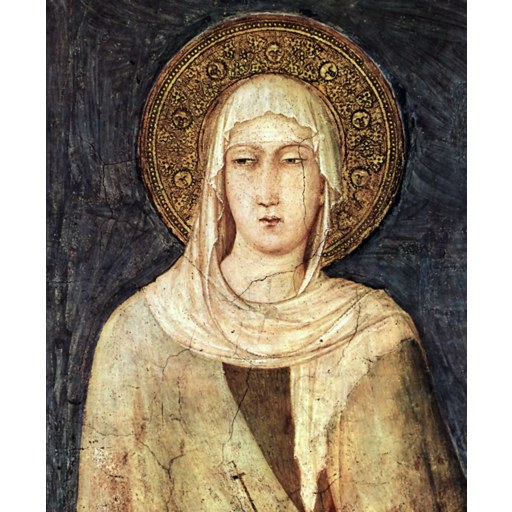
Simone Martini
License: Public domain
Clare of Assisi
Saint- Life Span
- 1194 - 1253 (age 59)
- Feast Day
- August 11
- Gender
- female
- Church
- Catholic
Places


Relics & Where to Venerate
Location unknown
The bodily remains of Clare of Assisi are a first-class relic. Venerated at Basilica di Santa Chiara.
Housed at Basilica di Santa Chiara · Italy
Bodily relics of St. Clare of Assisi enshrined in the Basilica of Santa Chiara in Assisi.
Roles & Family
Religious Information
Patronage
television;eye disease;goldsmiths;laundry workers;embroiderers;gilders;needleworkers;good weather;Assisi;Santa Clara, California
Canonization
Biography
Clare of Assisi, born Chiara Offreduccio in Assisi in 1194, was the eldest daughter of the nobleman Favarone di Offreduccio and his wife Ortolana. Raised in a wealthy household of the Assisi nobility, she received a pious upbringing; her mother Ortolana was herself noted for pilgrimage and devotion, having traveled to the Holy Land, Rome, and the shrine of Saint Michael at Monte Gargano. Clare grew up during a period of civic strife between the greater and lesser nobility of Assisi and the neighboring city of Perugia, and her family belonged to the class of urban knights. Contemporary and near-contemporary sources, including the acts of her canonization process, describe her as already inclined toward austerity and almsgiving in adolescence, and as having refused advantageous marriage proposals.
In 1212, after hearing Francis of Assisi preach, Clare resolved to embrace the evangelical life he had begun a few years earlier. On the night of Palm Sunday she left her family palace and was received by Francis and his brothers at the Porziuncola, the small church of Santa Maria degli Angeli below Assisi. Francis cut her hair in a rite of consecration and clothed her in a rough habit. Because no house yet existed for women following his way, she was placed first with Benedictine nuns at San Paolo delle Abbadesse near Bastia Umbra and then at Sant'Angelo in Panzo on the slopes of Mount Subasio. Her sister Catherine soon followed her and received the name Agnes. Within a short time Francis established Clare and her companions at the church of San Damiano, just outside Assisi's walls, which became the motherhouse of the community later known as the Poor Ladies, or Poor Clares.
At San Damiano Clare served as abbess for some four decades, governing a community that practiced radical poverty, manual work, enclosure, and continual prayer. She resisted repeated attempts by popes and cardinals to impose on her sisters a rule that would allow communal property, insisting instead on the privilege of poverty that Francis had obtained for them. Only in 1253, as she lay dying, did Pope Innocent IV confirm the Rule she herself had written, the first monastic rule known to have been composed by a woman. Clare's correspondence, especially her letters to Agnes of Prague, shows a theology of poverty centered on following the poor Christ and on contemplative union with God. She was credited in her lifetime with numerous healings and with the defense of Assisi: when imperial troops and Saracen mercenaries threatened San Damiano around 1240 and 1241, tradition holds that she had the Blessed Sacrament brought before the attackers, after which they withdrew.
Clare's health declined in her later years; she spent long periods confined to her cell yet continued to spin cloth for altar linens and to guide her sisters. A well-known episode, recorded in the canonization process, relates that on Christmas she was too ill to attend Mass and received a vision of the liturgy celebrated in the church of Saint Francis, an incident later cited when she was named patron of television. She died at San Damiano on 11 August 1253, having received papal confirmation of her Rule a day or two before. Pope Alexander IV, who as Cardinal Rainaldo had been protector of the order, canonized her at Anagni on 26 September 1255. Her body was first buried at San Giorgio in Assisi and later translated to the basilica built in her honor, Santa Chiara, where it remains. The Order of Saint Clare spread rapidly across Europe in the thirteenth century and remains a major enclosed branch of the Franciscan family.