Clotilde is a saint of the Catholic Church (d. 545). Clotilde's feast day is celebrated on 3 June. Clotilde is the patron saint of queens;widows;brides;adopted children;parents;exiles;the lame;those who have suffered the death of children;Les Andelys.
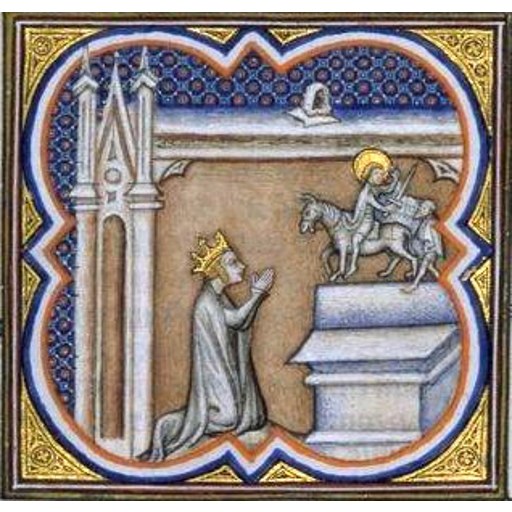
Unknown authorUnknown author
License: Public domain
Clotilde
Saint- Life Span
- d. 545
- Feast Day
- 3 June
- Gender
- female
- Church
- Catholic
Places

Relics & Where to Venerate
Location unknown
The bodily remains of Clotilde are a first-class relic. Venerated at Notre-Dame de Paris.
Roles & Family
Religious Information
Patronage
queens;widows;brides;adopted children;parents;exiles;the lame;those who have suffered the death of children;Les Andelys
Biography
Clotilde (also rendered Clothilde, Clotilda, or, in Frankish forms, Chrodechildis or Chlothildis) was a Burgundian princess who became queen of the Salian Franks as the wife of Clovis I. She belonged to the royal house of the Burgundians, a people settled in eastern Gaul whose kings were generally Arian Christians. Her father was Chilperic II, a Burgundian king; her mother, often named Caretena in later tradition, appears to have been Catholic, and Clotilde herself was raised in the Nicene faith. In the brutal intra-dynastic conflicts of the late fifth century, Gundobad, Chilperic's brother, had Chilperic killed and Clotilde's mother put to death. A sister, Chrona (sometimes called Sedeleuba), took the veil. Clotilde remained at the Burgundian court until a marriage was arranged with Clovis, the still-pagan king of the Franks, an alliance Gundobad accepted in the early 490s. No contemporary source records her exact year of birth; modern reference works offer only approximate dates in the 470s.
As queen, Clotilde made the conversion of her husband her principal religious aim. Gregory of Tours, the principal narrative source for her life, describes her persistent exhortations that Clovis abandon the gods of his people and accept Catholic baptism. Their first son, Ingomer, was baptized at her insistence and died in infancy; Clovis treated the death as evidence against the Christian God. A second son, Chlodomer, was also baptized and lived. The turning point in the traditional story is a battle against the Alemanni, commonly identified with the engagement at Tolbiac: hard pressed, Clovis invoked the God of Clotilde, won the field, and thereafter received instruction from Remigius, bishop of Reims. Clovis's baptism, together with that of a large number of Frankish warriors, is usually placed in the closing years of the fifth century (Christmas of 496 is the date long given in Frankish tradition, though modern historians have also proposed later years). Because Clovis accepted the Catholic rather than the Arian form of Christianity, the Franks became aligned with the Gallo-Roman episcopate and with the papacy, a choice of lasting consequence for the religious map of the medieval West.
Clotilde and Clovis had four children who figure in the political history of the sixth century: the sons Chlodomer, Childebert I, and Chlothar I, who partitioned the Frankish realm after Clovis died in 511, and a daughter named Clotilde, who was married to Amalaric, the Arian king of the Visigoths in Spain. During her years as queen, Clotilde was associated with pious foundations, above all the basilica of the Holy Apostles (Saints Peter and Paul) in Paris, later known as the Abbey of Sainte-Geneviève, which served as the burial church of Clovis. After she was widowed she left the court and took up residence at Tours, beside the tomb of Saint Martin, the great Gallic confessor. There she lived in austerity, prayer, and almsgiving, exercising the influence of a royal widow rather than that of a reigning queen. She did not enter a formal religious order in the later canonical sense, but her widowhood was lived in a monastic spirit of penance and charity.
The last decades of her life were overshadowed by the wars among her sons and by the destruction of her grandchildren. Chlodomer was killed in 524 in a campaign against Burgundy. Clotilde gathered his three young sons under her protection at Paris, but Childebert and Chlothar seized the boys: two were murdered so that their uncles might take their inheritance; the third, Clodoald, escaped and later became a monk, remembered as Saint Cloud. Clotilde's daughter, sent to the Visigothic court, was mistreated because she remained Catholic; she appealed to her brothers, was recovered by Frankish arms, and died on the journey or soon after her return. Gregory of Tours presents the aging queen as bearing these calamities with faith, occupying herself with the churches of Tours and with works of mercy rather than with revenge.
Clotilde died at Tours on 3 June in the mid-sixth century; liturgical and historical tradition has long assigned the year 545. Her body was carried to Paris and buried beside Clovis in the church of the Holy Apostles. Veneration of Clotilde as a saint grew in Francia on the strength of her part in the conversion of the Franks and of the holiness attributed to her widowhood. She was never the object of a later papal process of beatification or canonization; her cult is of the early, immemorial kind. The Roman Martyrology commemorates her on 3 June. In later Catholic devotion she has been invoked as a patron of queens, widows, brides, parents, adopted children, exiles, the lame, and those who have suffered the death of children, and she is associated with the town of Les Andelys in Normandy, where a church and a tradition of her patronage took root in the Middle Ages.