Coelius Sedulius is a saint of the Catholic Church.
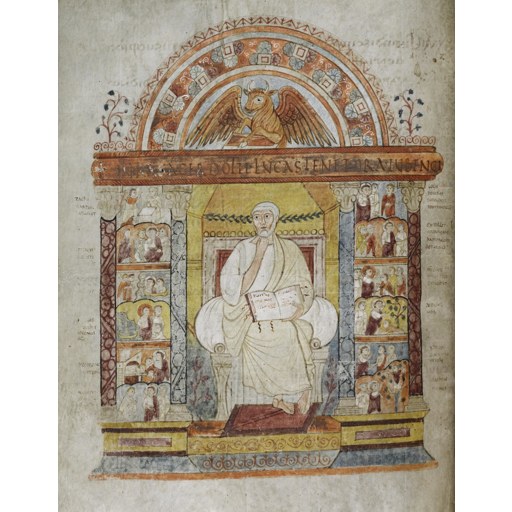
Unknown scribe
License: Public domain
Coelius Sedulius
Saint- Gender
- male
- Church
- Catholic
Places
Roles & Family
Biography
Coelius Sedulius, also known as Caelius Sedulius or simply Sedulius, was a Christian Latin poet of the first half of the fifth century. Almost nothing about his life can be established with certainty from contemporary evidence. Later manuscript notices, of uncertain reliability and often dated only to the early medieval period, describe him as a convert from paganism who studied philosophy in Italy and subsequently taught or composed in Achaia or elsewhere in Greece; modern scholarship treats those particulars as legendary or at best unproven. What can be said more securely is that he was active during the joint reign of the Eastern emperor Theodosius II and the Western emperor Valentinian III, hence in the second quarter of the fifth century, and that he addressed a dedicatory letter to a priest named Macedonius, who appears to have encouraged his literary work. Isidore of Seville, writing in the seventh century in De viris illustribus, identified Sedulius as a priest (presbyter). The additional nomen Coelius or Caelius appears in some manuscripts of his poems but may be a later accretion rather than a name he himself used. No reliable evidence records his place of birth or death, his family, or the year of either event.
Sedulius’s principal work is the Carmen Paschale, a hexameter epic in five books that retells salvation history with particular emphasis on the Gospel narratives. The first book surveys miracles and figures of the Old Testament as types and prefigurations of Christ; the remaining four books narrate the incarnation, ministry, miracles, passion, death, and resurrection of Jesus. The poem is composed in a consciously classical, Virgilian style and belongs to the tradition of late antique biblical epic inaugurated in Latin by Juvencus in the fourth century and later continued by Arator and others. Sedulius aimed not merely to versify Scripture but to present Christ’s saving work as the true paschal fulfillment of earlier sacred history, combining paraphrase, typology, and brief exegetical comment. He also produced a prose counterpart, the Opus Paschale, covering substantially the same material in a more expansive, rhetorical, and explanatory manner. In his letter to Macedonius he explained that he had first treated the subject in verse and had then recast it in prose, a double treatment that reflects late antique habits of working the same theme in more than one genre.
Two liturgical hymns are attributed to Sedulius and were widely used in the medieval Western church. A solis ortus cardine is an abecedarian hymn of twenty-three stanzas, each beginning with a successive letter of the Latin alphabet, recounting the life of Christ from the Incarnation onward. Portions of this hymn entered the Divine Office for Christmas and related feasts; a continuation or excerpt associated with Epiphany is often cited under the opening Hostis Herodes impie or Crudelis Herodes Deum. A second hymn, Cantemus socii Domino, is a shorter composition connected with Easter. Through these hymns Sedulius obtained a lasting place in Christian worship even among clergy and choirs who never read the Carmen Paschale as a complete literary work. The hymns display the same concern for the whole arc of Christ’s life that structures the epic, and they helped carry his name far beyond the circle of readers of biblical epic.
The Carmen Paschale became a standard school text in the Latin Middle Ages and was frequently copied, glossed, and imitated in monastic and cathedral schools. Already in the sixth century Venantius Fortunatus ranked Sedulius among the principal Christian poets. The so-called Decretum Gelasianum, a sixth-century list of received and rejected books, included Sedulius among authors whose works might be read. Encyclopedists, grammarians, and commentators from Isidore and Bede through the Carolingian scholars transmitted, excerpted, and studied him, and his combination of classical poetic technique with biblical narrative made him a model for later Christian Latin verse. Despite this extensive literary fame, the concrete facts of his biography remain obscure. Places of birth and death, precise dates, membership in any religious order, and any record of marriage or children are not attested in sources that meet a historian’s standard of verification. He is not recorded as having held the papacy or a patriarchal see, and he is not securely assigned a feast day in the principal martyrologies as a canonized saint in his own right, though his hymns continued to be sung in the liturgy for many centuries.