Columbanus is a saint of the Catholic Church (543 - 615). Columbanus's feast day is celebrated on 23 November. Columbanus is the patron saint of motorcyclists;Bobbio.
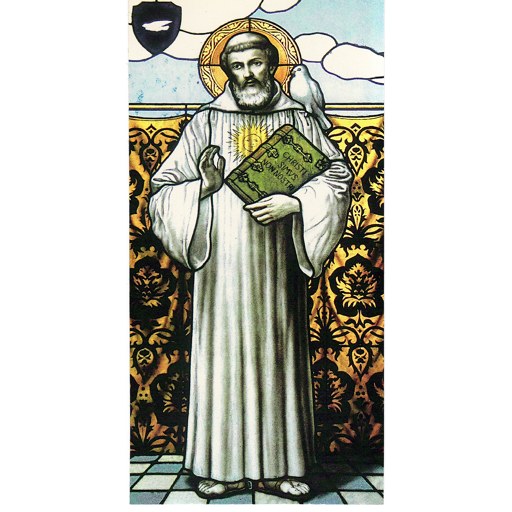
Unknown authorUnknown author
License: Public domain
Columbanus
Saint- Life Span
- 543 - 615 (age 72)
- Feast Day
- 23 November
- Gender
- male
- Church
- Catholic
Places

Relics & Where to Venerate
Location unknown
The bodily remains of Columbanus are a first-class relic. Venerated at Bobbio Abbey.
Housed at Bobbio Cathedral · Italy
== Veneration == The remains of Columbanus are preserved in the crypt at Bobbio Abbey
Roles & Family
Religious Information
Patronage
motorcyclists;Bobbio
Canonization
Biography
Columbanus (also Columban) was born in the province of Leinster in Ireland in the mid-sixth century, the year 543 being the date long given in the Latin and Irish tradition. His principal biographer, Jonas of Bobbio, who wrote at Bobbio within a generation of the saint’s death, describes a youth of unusual learning in grammar, rhetoric, geometry, and the Scriptures. Jonas also records that Columbanus, who was of striking appearance, was troubled by worldly and sexual temptation; a pious woman living as an anchoress warned him that he could not serve God amid such dangers and that he must leave his native land. Over the opposition of his mother, who is said to have lain across the threshold to prevent his departure, he embraced the monastic life. He studied first under Sinell at Cluain Inis on Lough Erne and then entered the great monastery of Bangor in Ulster under Abbot Comgall, where he remained for many years as monk and teacher.
Around 590 Columbanus left Ireland as a peregrinus pro Christo, a voluntary exile for Christ, taking twelve companions, among them Gall and Attala. After landing in Brittany they entered the Merovingian kingdoms of Gaul and were received in Burgundy. In the Vosges he established a hermitage at Annegray and then the larger houses of Luxeuil and Fontaine. Luxeuil quickly became one of the most influential monasteries in Frankish Gaul, a centre of Irish observance, learning, and the private tariffed penance that Columbanus helped to spread on the Continent. He governed by a severe rule of his own composition (the Regula monachorum and Regula coenobialis) rather than the Rule of Benedict. His community kept the Irish tonsure and the Irish computation of Easter, practices that brought him into open conflict with the Gallic episcopate. He defended the Irish customs in letters to Pope Gregory the Great and later to Pope Boniface IV, and he also wrote a penitential, a series of sermons (Instructiones), and Latin verse.
Relations with the Burgundian court collapsed in the first decade of the seventh century. Columbanus rebuked King Theuderic II for keeping concubines and refused to bless the king’s illegitimate sons; he likewise opposed the power of the queen-grandmother Brunhilda. About 610 he was seized and ordered to be deported to Ireland. A storm turned the ship back from Nantes, which Jonas presents as divine intervention. Columbanus then passed through Neustria, where King Chlothar II received him, and into Austrasia. With some of his monks he worked among the Alemanni around Lake Constance, notably at Bregenz; his companion Gall remained in that region and became the eponym of the later abbey of St. Gallen. After the defeat of Theudebert II, Columbanus crossed the Alps into the Lombard kingdom of Italy.
King Agilulf and the Catholic queen Theodelinda granted him land in the Trebbia valley in the Apennines. There, in 614, he founded the abbey of Bobbio, which became a major scriptorium and a stronghold of Nicene orthodoxy in a kingdom still marked by Arianism. Columbanus died at Bobbio on 21 November 615 and was buried in the monastery he had established. His foundations formed a Columbanian familia that carried Irish monastic culture, penitential discipline, and scholarship deep into Frankish and Lombard lands; in later generations many of those houses combined his customs with the Benedictine Rule. He has been venerated as a saint since the seventh century. The Roman Martyrology keeps his feast on 23 November. In modern devotion he is invoked as patron of Bobbio and, by a more recent popular association, of motorcyclists.