Confessor Albinus is a saint of the Catholic Church (d. 550). Confessor Albinus's feast day is celebrated on March 1. Confessor Albinus is the patron saint of Angers;the diocese of Angers;prisoners;protection against pirate attacks.
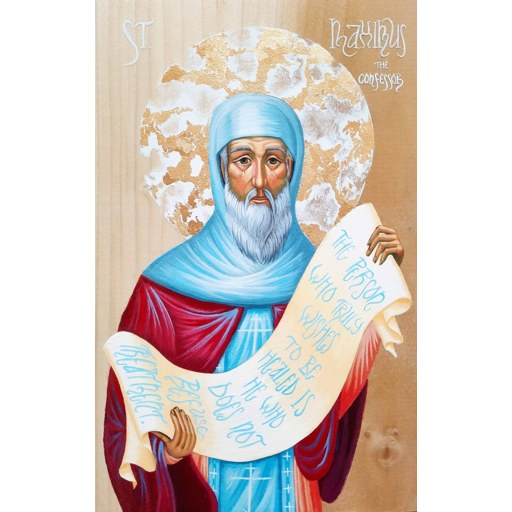
https://etsy.com/listing/1294340881/partly-hand-paintedgilded-st-maximus-the
License: unknown
Confessor Albinus
Saint- Life Span
- d. 550
- Feast Day
- March 1
- Gender
- male
- Church
- Catholic
Places
Roles & Family
Patronage
Angers;the diocese of Angers;prisoners;protection against pirate attacks
Biography
Saint Albinus, known in French as Saint Aubin, was a bishop of Angers in western Gaul during the first half of the sixth century and is commemorated in the Roman Martyrology as a bishop and confessor. He was born of a noble family in the territory of Vannes in Brittany (Armorica). From youth he entered the monastic life at a community traditionally called Tincillac (or Cincillac), of which he later became abbot. His reputation for austerity, hospitality, and care for the poor led the clergy and people of Angers to elect him bishop, an office he is generally held to have assumed in the later 520s, in the Merovingian kingdom of the Franks.
As bishop he was remembered for defending ecclesiastical discipline and the vulnerable. Near-contemporary tradition, especially the Life composed by Venantius Fortunatus at the request of a later bishop of Angers, presents him as an opponent of simony and of incestuous marriages among the nobility; he is said to have remonstrated with King Childebert I on the latter point. He took part in the Third Council of Orléans in 538, which issued canons on clerical life and morals. Hagiographical accounts attribute to him the liberation of prisoners (prison doors opening after his prayer) and various healings. Gregory of Tours, writing later in the same century, recorded miracles associated with Albinus’s tomb and thereby attests to an early cult.
Albinus died at Angers on 1 March, in a year traditionally given as 550. He was first buried in the church of Saint-Pierre. Devotion grew quickly; a monastery rose at his tomb and became the Abbey of Saint-Aubin, to which his relics were translated. His cult spread through Anjou, Brittany, and other parts of western France. Numerous parishes and communes named Saint-Aubin preserve his dedication. He is patron of the city and former diocese of Angers and has long been invoked for the release of captives. In later medieval coastal regions his relics were carried in procession in time of danger, which associated him with protection against pirate and raiding attacks.
The principal narrative sources remain Fortunatus’s sixth-century vita and the notices of Gregory of Tours. These are hagiographical in character and do not supply a documented year of birth; later estimates around 470 are inferences from his career, not contemporary records. Formal papal canonization in the later medieval sense did not apply; he was venerated as a saint from the Merovingian period onward (pre-congregation). His feast is kept on 1 March.